




When Danijela Jelich was 19, her father, Steven, died of sudden cardiac arrest.
"My dad's death changed my life forever," said Jelich, a biology major at Western. "In that moment, I decided to turn my pain into purpose."
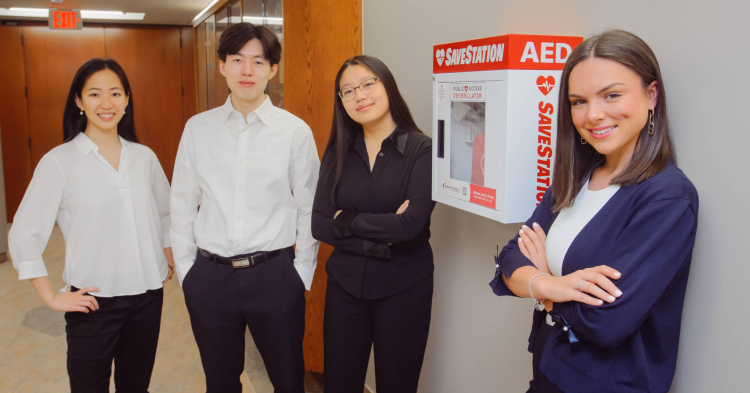
Since her father's death in 2023, biology major Danijela Jelich (right) has made it her mission to raise awareness on campus about cardiac arrest. She's trained hundreds of students in CPR, enhanced Western's automated external defibrillator (AED) program and co-founded Western's AED Student Awareness Team. (L to R): Dora Zhao, Jason Chu, Lily Lu and Danijela Jelich. (Christopher Kindratsky/Western Communications)
Since then, Jelich has been driven to raise awareness about cardiac arrest at Western, training hundreds of students in CPR and working to enhance the campus automated external defibrillator (AED) program - including raising money for the university's first outdoor AED, which will be installed and operational by March 31.
"I want everyone on campus to be ready to save a life, and for Western to lead the way as the gold standard for other universities," she said.
Just over six months after her father died in March 2023, Jelich and her family organized an event on campus for World Restart a Heart Day. They trained more than 300 people on how to perform CPR, AED usage, as well as basic skills and knowledge about cardiac arrest.
Teaching people how to respond in a cardiac emergency was just the beginning. Jelich knew that if someone needed an AED, students and staff had to be able to find one quickly, and trust that it would work.
Working to make Western campus-ready to save a life
Jelich partnered with Campus Safety and Emergency Services (CSES) to locate and confirm all available devices university-wide. She had help from Western's AED Student Awareness Team, a group Jelich co-founded to champion the devices across campus. Along with Jelich, team members Jason Chu, Dora Zhao and Lily Lu connected with Action First Aid, a Canadian company that provides first aid, CPR and AED training, and supports large-scale AED programs.
"We compiled a full, accurate list of what was then 52 AEDs on campus and made sure they were all fully operational with all the required supplies and signage," Jelich said.
The AED team also began reviewing campus building floor plans to identify where additional AEDs may be needed as part of Western's long-term cardiac emergency planning.
"Our goal was to improve access so defibrillation can be delivered within the critical 3- to 5-minute window after a cardiac arrest," Jelich said.
The AED team's partnership with CSES has led to a broader shift in how the university manages its AED units. Their deployment and maintenance, once managed at the faculty and department level, now fall under CSES.
The team works closely with campus community resource officer Lee Butler, who completes monthly checks to ensure every device is operational.
The work has already paid off in a tangible way. A staff member recently went into cardiac arrest in a campus residence building - and survived - thanks to a nearby AED Jelich had recently inspected.
"Danijela and the AED team have been amazing," said Bill Chantler, CSES director. "The passion and energy Danijela brings to raising awareness about cardiac arrest, CPR and AEDs on campus has made our campus a safer place and will save lives."
A program led by CSES and supported by the AED Student Awareness Team registered every AED on campus through the PulsePoint AED Locator app, which displays each device's location with a photo and description to help people find it quickly in an emergency.
Chantler encouraged all Western community members to download the app.
Understanding cardiac arrest
Each year, roughly 60,000 Canadians suffer cardiac arrest, with up to 85 per cent of cases occurring outside hospitals. Each minute without intervention drops the chance of survival by 10 per cent. Public AEDs, accessible before paramedics arrive, are among the most effective tools available.
Unlike a heart attack, which occurs when blood flow to the heart is blocked, cardiac arrest is an electrical failure that causes the heart to stop beating and the person to lose consciousness instantly. CPR can keep blood circulating, but only an AED can restore a normal heart rhythm.
Broadening CPR and AED training across campus
In March 2024, Jelich and the team hosted Heart2Heart: Saving Lives Together, an event centered on CPR and AED education, awareness and hands-on training. More than 60 Western students, faculty and staff received CPR and AED training. Attendees also heard from guest speakers, including cardiologists, a resuscitation researcher and a cardiac arrest survivor. The event also raised funds for the Heart and Stroke Foundation.
Jelich has since taken the training even further across campus.
A member of the Western Mustangs figure skating team, she identified an opportunity to build on the existing CPR-C and AED instruction Western Sports and Recreation provides to key staff and personnel through its Standard First Aid training.
Working with Christine Stapleton, director of sports and recreation, Jelich developed a plan to train up to 800 additional people including student athletes, coaches and facilities and event staff. The response has been immediate, with the entire Western soccer program already booked for a session in September.
"Cardiac arrest can happen to anyone, including athletes," Jelich said. She points to Damar Hamlin, an NFL player who went into cardiac arrest after taking a blow to the chest during a 2023 game and survived because of immediate CPR and use of an AED on the field.
"His story is a perfect example of how a cardiac emergency plan is supposed to work - and a reminder of how quickly it can all go wrong without one," Jelich said.
Western's first outdoor AED coming to Concrete Beach
While there are currently more than 55 AEDs on campus, all are located inside buildings that are locked after hours. Knowing cardiac emergencies can happen at any time, Jelich was determined to address the gap.
She launched a SaveStation crowdfunding page last November, with a goal to raise $9,514 for Western's first outdoor SaveStation, a weather-protected, monitored AED cabinet that would be accessible 24/7. She shared a post on Instagram without directly asking for donations, expecting it would take months to raise enough funds. Support poured in over the next few hours.
"I kept getting dings' on my phone - one donation after another," she said. "It was overwhelming, in the best way."
Jelich surpassed her target, raising more than $13,000 - enough to install an outdoor SaveStation outside the University Community Centre (UCC) and an additional AED for the Ronald D. Schmeichel Building for Entrepreneurship and Innovation.These additional AEDs, along with others added over the past three years, mean there are now 58 AEDs stationed across campus.
The UCC SaveStation and the Schmeichel Building AED will be dedicated in memory of Jelich's father.
"I wish I wasn't doing this because my dad is gone, but I know it's a beautiful way to honour him," Jelich said.
***
The outdoor AED SaveStation will be unveiled March 31 at 11 a.m. on Concrete Beach, outside the University Community Centre.
Learn more about how Western is preparing future leaders and global citizens.


