




A Brock University research team has developed new materials that could increase the efficiency of batteries and hybrid energy storage devices.
Assistant Professor of Physics and Engineering Jasneet Kaur and her team are working to develop advanced battery separators using solid polymer electrolytes (SPEs).
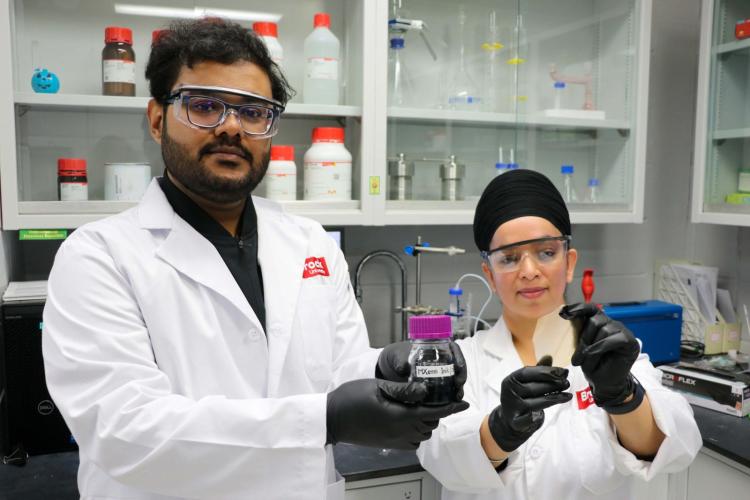
Assistant Professor of Physics and Engineering Jasneet Kaur (right) and PhD students Pritish Kumar Behura are part of a research team working to develop advanced battery separators using solid polymer electrolytes.
These membranes which can be made of SPEs, liquid electrolytes and a number of other materials physically separate the positive and negative terminals inside a battery while still allowing charged particles called ions to travel between them. Ionic movement, or ionic conductivity, is what allows batteries to generate an electric current.
Kaur says SPEs are promising materials for next-generation solid-state lithium-ion batteries because they are flexible, easy to manufacture and safer than conventionally used liquid electrolytes , which can be flammable.
"Using SPEs could help protect the environment by making batteries safer, longer-lasting, and more efficient reducing waste and supporting the transition to clean energy technologies," she says.
But ions in SPEs move relatively slowly, Kaur says, making them less effective as conductors.
"As a result, batteries charge more slowly, deliver power less efficiently and may lose performance over time due to limited ion mobility," she says.
Her research team, which includes physics master's student Hansima Keppetiyawa and PhD students Pritish Kumar Behura and Teresa Dong, searched for a way to increase SPE conductivity.
After closely examining some of the properties of commercial membranes, the team synthesized advanced material called titanium carbide MXene and incorporated that into different polymer matrices to create SPE membranes.
"We found that the membranes made with the MXene material were stronger and more effective at facilitating ion transport between the battery's positive and negative terminals," Kaur says. "These ultrathin MXene structures act like highways for faster ion conduction."
Kaur says these traits make the team's new SPEs ideal for use in next-generation solid-state batteries.
"Conventional membranes start to degrade at higher temperatures," adds Behura. "In contrast, our membrane remains stable under high-temperature and high-humidity conditions, which could improve battery performance and sustainability in extreme environments."
The team's findings are outlined in their paper, "Titanium Carbide MXene Enabling Temperature-Dependent High Ionic Conductivity in Solid Polymer Electrolytes," published March 3 in the journal Graphene and 2D Materials.
Kaur, Behura and researchers from Toronto Metropolitan University published another study in the Journal of Energy Storage Materials in March, "Ion-conductive 2D Materials Beyond Graphene for Electrochemical Energy Storage and Conversion Systems," reviewing research describing other materials that could be used to make SPEs more efficient. According to Kaur, this is the first comprehensive study that discusses the role of two-dimensional materials in ion-conduction phenomena in energy storage and conversion devices.
"Together, these studies provide new insights into how carefully engineered 2D materials can unlock new possibilities for high-performance clean energy technologies and wearable electronics," she says.


