




Naser Ezzati-Jivan says scholars risk making equity, diversity and inclusion (EDI) an afterthought when questions of fairness and representation aren't addressed early, and consistently, in the research process.
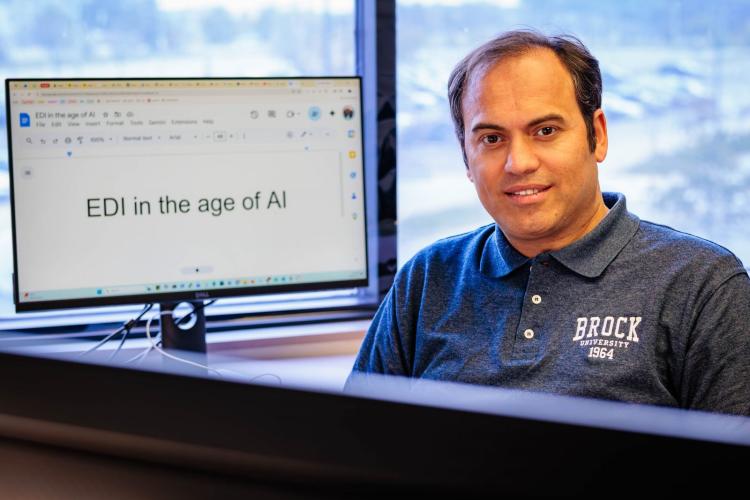
The Government of Canada' Dimensions Program has awarded Brock University $100,000 for research, led by Associate Professor of Computer Science Naser Ezzati-Jivan, on integrating EDI policies and practices into the research process.
The problem is magnified when researchers use artificial intelligence (AI) in their workflows, particularly when first starting to make research plans and complete grant applications, says the Associate Professor of Computer Science.
"EDI is challenging because it needs to be considered across multiple levels of research planning," he says. "When AI enters that process, it can deepen the challenge by introducing generic patterns, hidden assumptions, or biased framing early on, before those decisions have been carefully examined."
Ezzati-Jivan is heading up a project to create a bilingual guide and a digital decision-making tool that would allow Canadian scholars to more easily integrate EDI into their research planning, particularly when using AI. The open-access toolkit will be developed in partnership with equity-deserving groups.
Supporting the team's work is a $100,000 grant from the Government of Canada's Dimensions Program. Administered by the Natural Sciences and Engineering Research Council of Canada, these grants support projects that address EDI gaps in Canada's research ecosystem.
Ezzati-Jivan's team includes Professor of Information Systems Anteneh Ayanso, Assistant Professor of Information Systems Leila Tahmooresnejad and University of Ottawa Assistant Professor Paria Shirani.
The guide's "EDI-by-design framework" will include clear principles, process maps and role-specific guidance tailored to researchers, research offices and internal review committees, says Ezzati-Jivan.
Built into the framework are key elements of the research process where decisions related to EDI should be made, including research design, methodology, data collection, dataset choices, team formation, partnerships and review practices.
The system also outlines who should be responsible for implementing specific tasks these critical decision-making points along with prompts and examples reflecting how funding agencies interpret and assess EDI expectations.
While the digital decision-making tool will guide users through the framework, providing examples of good practices during the research process, Ezzati-Jivan says the system won't assess or judge research proposals and will still need human judgment.
Ezzati-Jivan says the team also aims to advance understanding where AI may amplify inequity in research and how it could be used to strengthen EDI in research planning.
"We would like this project to produce evidence-based guidance, tools and practical resources that help researchers recognize where AI may introduce bias and how that risk can be reduced," he says. "We also hope to learn directly from researchers, including Brock researchers, about the challenges they are facing in the era of AI, so that our outputs are grounded in real practice rather than assumptions."
Vice-President, Research Tim Kenyon says EDI principles and practices are core threads of Brock's Institutional Strategic Plan 2025-2030 and Research Enterprise Plan for 2025-2030, adding the University is also a signatory to the Dimensions Charter. Endorsed by Brock in 2019, the charter lays out eight principles post-secondary sectors commit to with the aim of fostering a culture of inclusivity, accessibility, reconciliation and decolonization.
"This new funding further supports our Brock community where all members contribute their ideas, knowledge and insights, creating an ecosystem in which research excellence flourishes and makes a positive difference in our community and beyond," Kenyon says.
Chris Bittle, Member of Parliament for St. Catharines, says the project reflects the Government of Canada's commitment to fostering a welcoming environment.
"The Brock University community, and particularly the work of Dr. Ezzati-Jivan's team, provides a great example of how we can build an equitable country where people of all walks of life are valued and their participation included in all spheres of society," he says.


