




Illuminated by an underwater light, a live camera feed captures a vibrant marine ecosystem where cunners, crab, lobster and sea urchins move among swaying kelp and algae-covered reef structures.
Every hour, a two-minute photoshoot takes place, capturing a snapshot in time. The imagery is immediately uploaded to an online visual library that researchers will document for years to come.
While the lobster and crab may be a little camera shy, the Marine Institute's Reef Ball Project in the Fox Harbour area of Placentia Bay hopes to capture them at any given moment and watch as the rich ecosystem brings its new home to life.
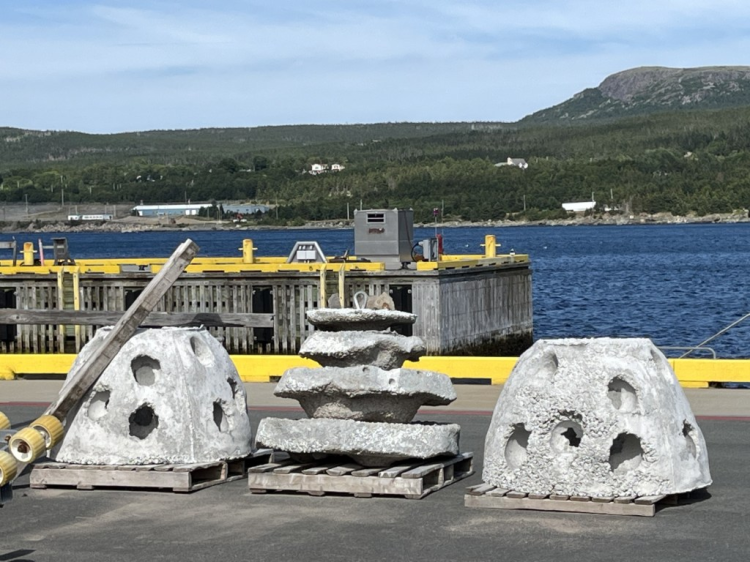
The reef balls before their installation on the floor of Placentia Bay. Photo: Submitted
The new underwater camera is the latest development in a project that began in the summer of 2025, when 285 concrete reef balls were installed, led by the Fisheries and Marine Institute of Memorial University.
The reef balls aim to restore and enhance marine habitat affected by vessel activity in the bay. The new underwater camera view is publicly accessible at any time, from anywhere with an internet connection.
Building a new underwater habitat
Reef balls are specially designed concrete structures that create complex underwater spaces where marine organisms can live, shelter and feed.
The installation forms an artificial reef, providing new habitat in an area where marine activity has affected the seafloor. But installing the reef is only the beginning.
Researchers want to understand what happens next, tracking which species move in and observing how the habitat changes over time, as well as how quickly marine life adapts to new surroundings.
"At the end of the day, healthy oceans benefit everyone," said Mark Santos, a fisheries technologist in the Centre for Sustainable Aquatic Resources. "This project is helping us better understand how marine habitats recover, how fish and other species use artificial reefs, and how we can use science to make better decisions that protect our oceans for the future."
A window beneath the surface
The camera sits approximately five metres below the surface, about 10 metres from the reef ball and uses a Reach Systems Auk camera from Valor Technologies.
The camera and its light activate for two minutes every hour. The first 30 seconds of each recording are transmitted through the cellular network to Memorial University's Centre for Analytics, Informatics and Research.
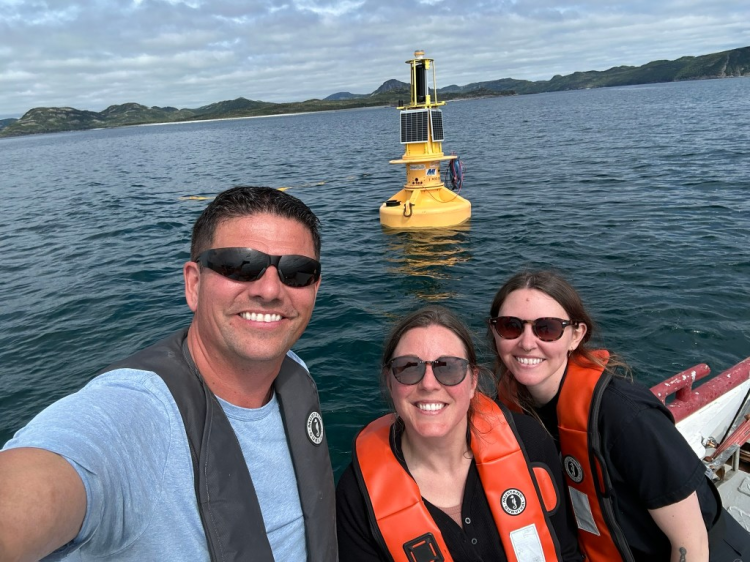
From left, Marine Institute researchers Mark Santos, Robyn Whelan and Courtney Weir celebrate a successful deployment. Photo: Submitted
Science from many angles
The underwater camera is just one part of a much larger monitoring effort.
Researchers have been using sonar surveys, remotely operated vehicles (ROVs), divers and long-term monitoring to build a detailed picture of how the artificial reef is developing.
Each method reveals something different, as sonar helps map the reef and surrounding seafloor. Divers can also make close-up observations of the structures and surrounding habitat. ROVs allow researchers to explore underwater areas while capturing video and imagery. Then, the camera system provides a long-term window into the reef between field surveys.
Together, these tools help researchers track changes that might otherwise go unnoticed.
Observing new beginnings
One of the most exciting questions is how marine life will respond.
Artificial reefs can provide surfaces for organisms to attach, as well as spaces for fish and other marine species to shelter and forage.
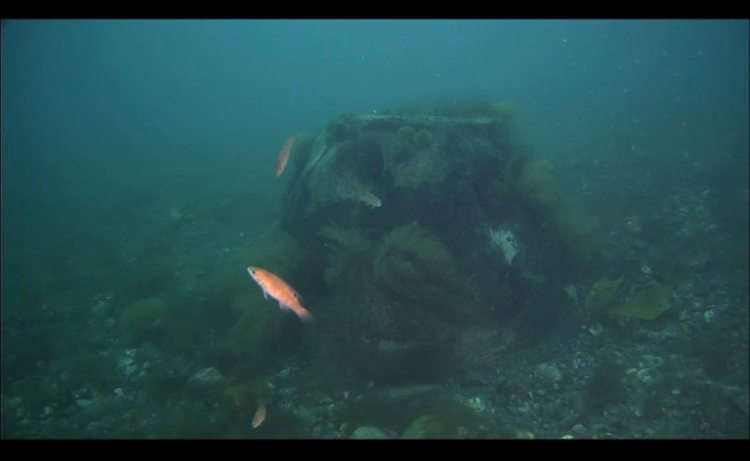
Sea life in and on one of the reef balls. Photo: Submitted
For Mr. Santos, the project is about more than what today's image is showing. The project is also about the future.
"We've been measuring the reef using sonar surveys, ROVs, divers, and long-term monitoring," he said. "Every survey gives us a better picture of how the reef is developing, and the information we're collecting will help improve future habitat restoration projects here in Newfoundland and Labrador."
A collaborative effort
The monitoring system is expected to remain in place for up to nine years. For Mr. Santos and his research team, this timeline is important, and so is collaboration.
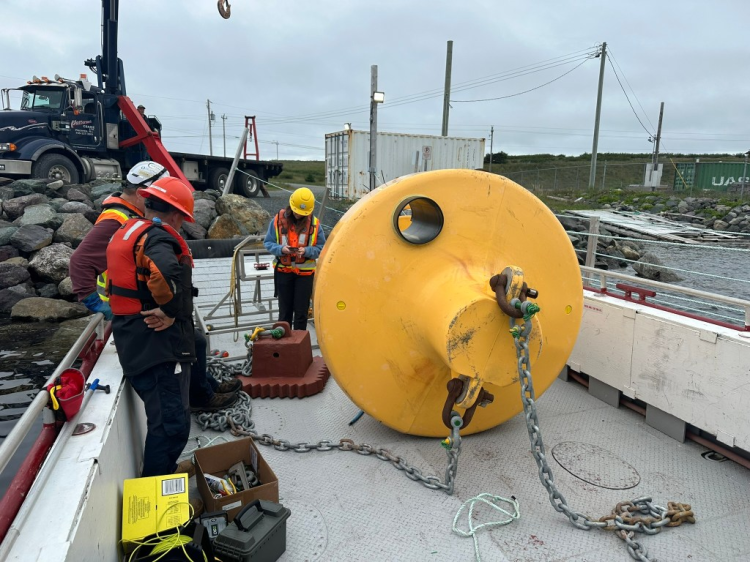
Marine Institute researchers Robyn Whelan, Courtney Weir and Mark Santos prepare a SmartAtlantic Buoy for re-deployment. It marks the site above the reef ball observatory. Photo: Submitted
The project brought together expertise from three centres at the Fisheries and Marine Institute: the Centre for Sustainable Aquatic Resources; the Centre for Fisheries Ecosystems Research; and the Centre for Ocean Technology, Environment and Design.
"At the Marine Institute, we have experts in everything from marine biology and fisheries science to ocean mapping and underwater technology," Mr. Santos said, adding that partnership is the key to success. "Bringing all that expertise together allows us to do research that's making a real difference, not just for this project, but for how we understand and manage our oceans here at home."
Explore the Fox Harbour reef-ball observatory on SmartAtlantic.ca!
For more information

230 Elizabeth Avenue
St. John's Newfoundland
Canada A1C 5S7
www.mun.ca


