




Carleton University's efforts to strengthen overall engagement with Africa took a significant step toward identifying priorities and opportunities for collaboration when a delegation from Carleton met with senior leaders and researchers from several African universities in South Africa in late September.
The partnership building trip by Carleton President Wisdom Tettey, African Indigenous Knowledge Research Network (AIKRN) founder and principal investigator Samuel Ojo Oloruntoba and Vice-Provost (Academic and Global Learning) David Hornsby included stops at seven South African universities and a pair of MOU signings to strengthen and advance bilateral collaborations.
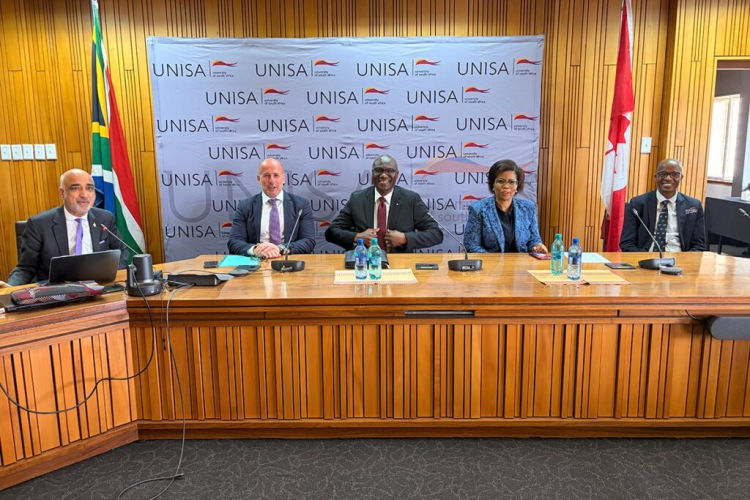
President Tettey meets with leaders at the University of South Africa
Specific Areas of Collaboration
Carleton's meetings with South African universities included conversations about specific areas in which the institutions can collaborate and action items to follow up on in the months ahead.
At the University of the Witwatersrand, quantum sensors and telecommunications were discussed, as were physics, geosciences, critical minerals and the potential for educational exchanges.
The agenda at the University of Johannesburg included food waste, food security and botany, as well as opportunities for student mobility within Africa.
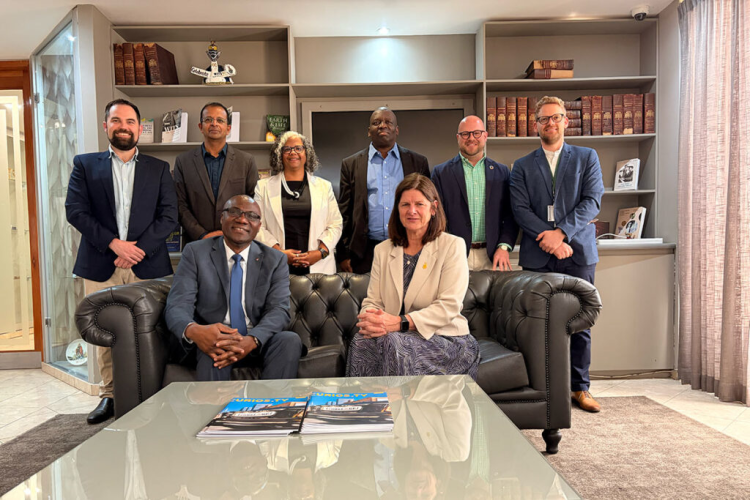
Carleton's delegation at the University of the Witwatersrand
Talks with the University of Pretoria ranged from Indigenous medicines and environmental justice to heritage studies and artificial intelligence.
Carleton's meeting with the University of KwaZulu-Natal explored ideas for sustainable innovation and youth empowerment in areas such as health care, food systems, restorative justice and climate resilience.
Conversations with the University of Cape Town focused on youth entrepreneurship and employability in fields such as traditional medicine, agri-business and creative industries.
At the University of South Africa (UNISA), a formal MOU was signed, outlining opportunities for staff and student exchanges, joint research and pilot projects, shared academic events and the exchange of academic resources.
Carleton also signed an MOU with the University of Venda around increased research collaboration.
These bilateral engagements are complementary to Carleton's national leadership role in the South Africa-Canada Universities Network (SACUN), which aligns higher education institutions in Canada with their partners in South Africa.
"Anchored within Carleton's internationalization strategy, these meetings will advance AIKRN's objectives of working with like-minded institutions committed to shifting the ecosystem on how Indigenous knowledge is perceived, studied, documented, appreciated and applied to sustainable livelihoods on the continent," says Oloruntoba.
"These meetings exceeded our expectations on every level," says Hornsby.
"The responses we received from our partners were very enthusiastic. Faculty at all of these universities talked about how they could contribute in their own unique ways and are willing to commit resources. These were focused articulations of what is possible."
Carleton Endorses the Africa Charter
The trip also included Carleton's formal endorsement of the Africa Charter for Transformative Research Collaborations.
Developed by leading African higher education and research organizations, the Africa Charter calls for a fundamental shift: recognizing African intellectual and institutional leadership and addressing imbalances in how research partnerships are designed, funded and valued.
Carleton joins approximately 130 institutions committed to advancing more equitable and transformative approaches to international research partnerships. President Tettey has served as a member of the charter's steering committee since its inception.
Innovation, Entrepreneurship and Youth Employment
The Africa Charter reflects the ethos of AIKRN, which was established in 2022 with support from the Mastercard Foundation and aims to recentre African Indigenous knowledge by connecting it with technology and global ideas, countering the historical silencing of African wisdom.
Under the co-leadership of Carleton and the University of Cape Town, partners from higher education, industry, NGOs, youth organizations and foundations across Africa and beyond gathered in Cape Town to turn their attention to unlocking entrepreneurship opportunities in Africa and to address youth unemployment through innovative uses of traditional knowledge, practices and beliefs held by Indigenous communities.
"The goal is for Carleton and its African partners to work together to create systems that translate African Indigenous knowledge and traditional ways of being and knowing into actual benefits for African communities, especially the youth," says President Tettey.
President Tettey with University of Johannesburg Vice-Chancellor and Principal Letlhokwa Mpedi
"AIKRN is foundational to this goal because it is rooted in transforming African ideas into advances that contribute to economic development, so that African communities become more self-sufficient."
Deliberations focused on a wide range of areas, including traditional governance, food security, biodiversity, agriculture, health and natural resource management.
"Carleton is well-positioned to be playing a leading role in this collaborative effort because of our expertise in areas such as health, engineering and business," adds Oloruntoba, a professor in Carleton's Institute of African Studies.
"AIKRN's collaborations will create opportunities for joint research projects, curriculum development, entrepreneurship and job creation in Africa. This is important because there is an increasing recognition that Indigenous knowledge holds massive potential toward addressing some of the most pressing challenges of our time, including climate change, poverty and inequality."
"The partnerships that we are forging and strengthening, the collaborations we are advancing through AIKRN and our commitment to the principles of the Africa Charter matter because of the moment we are in requires a transformation of the global order," adds President Tettey.
"As universities, we are key players in that transformation, and together with our African partners we have an opportunity to do something consequential: to help build a more equitable global order, not merely reflect the existing one."


