




"Am I dreaming? Am I awake?"
That was Sahar Kamil's first reaction when she learned she had won the Canada Graduate Scholarship - Doctoral from the Canadian Institutes of Health Research (CIHR). The award is worth $120,000 over three years.
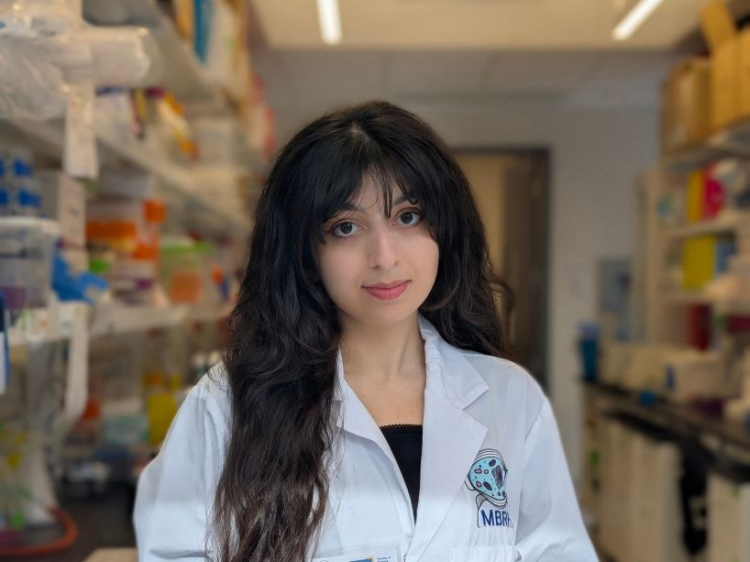
Sahar Kamil is a molecular science PhD student at TMU and a recipient of the Canada Graduate Scholarship - Doctoral from the Canadian Institutes of Health Research.
Kamil is a molecular science PhD student at TMU.
"It came as a total surprise to me, and I think it's because this came after a very long string of consistent rejections and failures that I had gone through. So it was really humbling and very surreal," says Kamil.
The CIHR award supports doctoral students whose research focuses on health and disease. Kamil will use it to continue her research at TMU on how cell surface proteins control breast cancer progression. These are proteins found on the outside of cells that can define how cells grow in health and disease.
"I'm fortunate that I get to start off my PhD strong with an award that empowers me to ask these questions, it is an honour to be supported and recognized at an international level," says Kamil. " I am fortunate to be well supported during my doctoral training with this award, as it will support me in making important research progress towards understanding how cells work in cancer."
How Kamil got into cancer research
Kamil's interest in cancer biology research started in an undergraduate cell biology course. Her professor, Costin Antonescu, is now her PhD supervisor. He teaches in TMU's Department of Chemistry and Biology.
In her fourth year, Antonescu took her on as an undergraduate thesis student. It was her first taste of research.
"After that, I was pretty sold, and I knew for sure I wanted to continue my grad studies at TMU in his lab, working on really exciting stuff," says Kamil.
That's exactly what she did. As a molecular science PhD student, Kamil studies how cells work in health and disease. She focuses on how cancers like breast cancer work at the cellular level.
"It has been a wonderful experience to work with Sahar, and I am delighted to see her recognized with this prestigious award. Sahar's creativity and perseverance have set her on a track towards success, poised to make an impact in cancer cell biology research," says Antonescu.
Learning to handle rejection in science
Kamil almost didn't apply for the CIHR grant. Antonescu encouraged her and reviewed her application.
The win changed how she sees her future in science. She loves research, but after earlier rejections, she wondered whether a science career was for her.
"It can be really hard to stay resilient in science," says Kamil. "So the biggest thing that this award gave me is the opportunity to see what happens when you keep pushing through. I am grateful to have this work supported and also to have my potential as a researcher recognized by CIHR."
Antonescu also hosts a yearly talk about his own experiences with rejection in science. Kamil says it opens up a conversation and helps students keep failure from shaping how they see themselves as scientists.
"So I think if it weren't for that, I honestly would not have even bothered applying. It was really him encouraging us to keep going, keep being resilient," says Kamil.
Making her family proud
Kamil has mostly found her way through university on her own. Her parents came to Canada as refugees from Afghanistan, and neither went to school beyond high school when they arrived.
When Kamil told her mom about the award, her mom was thrilled. She immediately called relatives back home to share the news.
"My mom grew up in an environment where they didn't let girls go to school," says Kamil. "I know education means a lot to her, so I was really happy I could make her proud because I know she has done a lot for me."
Kamil hopes her research will lead to important discoveries about breast cancer at the cellular level. She also has advice for other students facing rejection: don't let it define you as a scientist.
"Don't let that determine what the future looks like for you, and try to reframe failure as a lesson that you can apply for the next opportunity," she says


