




A new student-led research project at the University of Toronto will start with a simple premise: before bringing better internet to remote communities in Canada, ask the communities themselves what they actually need.
The project by the Reach Alliance - a global research consortium founded at U of T with the Mastercard Center for Inclusive Growth - brings together students from U of T and University College London (UCL) to work with experts at Canadian satellite company Telesat on improving high-speed internet connectivity in Canada's remote regions.
With support from faculty at both universities, the team will spend about 12 months studying how access to satellite-based services could improve the lives of residents of remote communities, focusing on what they need and what stands in the way.
"People think of [the internet] as a luxury, but in many ways it's really a necessity for health care, for education - just for connectivity in general," says Kate Haberl, who is pursuing her master's degree in global affairs at U of T's Munk School of Global Affairs & Public Policy in the Faculty of Arts & Science.
In 2025, for example, more than 97 per cent of households nationally had access to the internet at speeds of 50 megabits per second for downloads and 10 for uploads, with unlimited data, according to the Canadian Radio-television and Telecommunications Commission's Facilities Survey and census information from Statistics Canada. By contrast, only 70 per cent of households in the territories had similar levels of access.
However, Haberl says the Reach project isn't just focused on the infrastructure gap, which is relatively well understood, so much as the people being left behind.
"There's also barriers in things like cultural competency, in building trust with communities and in understanding their actual needs," says Haberl, who previously earned a master's degree in public administration from the London School of Economics. "What are the solutions that they want?"
The team's U of T members also include Skyler Jiayi Du, a fourth-year bachelor of information student at the Faculty of Information, and Rediet Mideksa, a student in the master of health informatics program in the Institute of Health Policy, Management and Evaluation at the Dalla Lana School of Public Health.
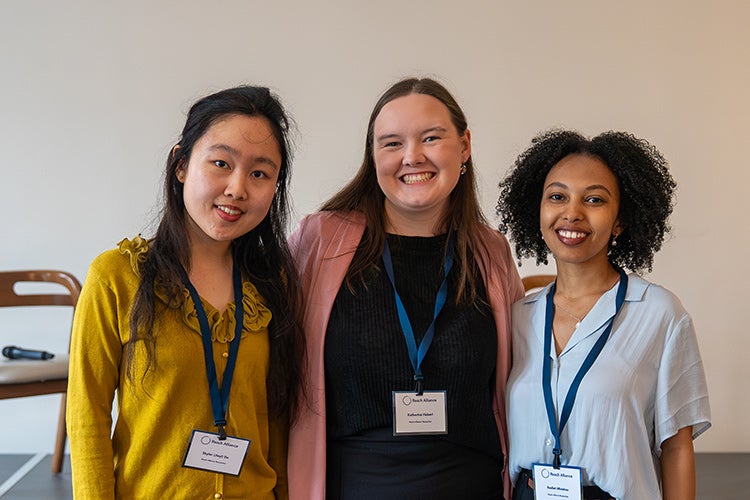
From left: U of T students Skyler Jiayi Du, Kate Haberl and Rediet Mideksa (photo by Danny Choi)
The trio brings their diverse backgrounds to the project: Mideksa previously worked with doctors and nurses to provide free care in rural communities; Du has experience in political science and urban planning; and Haberl previously worked at the BC Treaty Commission, which facilitates negotiations between First Nations and the provincial and federal governments.
"This project gives our students the chance to work with peers at UCL and experts at Telesat on solving a critical challenge with communities across the country - while learning what it takes to turn research into real-world impact," says U of T President Melanie Woodin.
While U of T and UCL have collaborated through the Reach Alliance since 2021, the Telesat project marks the first time the two institutions have partnered on a student research team. The joint Reach project also aligns with the two universities' bicentennials - with UCL marking its 200th anniversary this year and U of T gearing up for its own celebrations in 2027.
"UCL's collaboration with the Reach Alliance offers students a valuable opportunity to work across borders, disciplines and sectors to address real-world challenges," says UCL President and Provost Michael Spence.
"It is a powerful example of how international collaboration can enrich learning, generate new knowledge and create meaningful impact beyond the classroom.
Telesat's engineers and communications professionals will work alongside the students as part of the project, which is scheduled to launch next year.
"Closing Canada's connectivity gap will require collaboration across industry, governments, academia and communities," says Ted Baker, Telesat's senior director, carrier and enterprise sales. "With Telesat's nearly six decades of expertise in satellite connectivity solutions, we're honoured to support and inspire the next generation of innovators and leaders who will transform research and ideas into solutions that create lasting social and economic impact."
The collaboration comes as Canada's economic resilience, public services, emergency preparedness and people's participation in society become increasingly dependent on reliable connectivity. At the same time, advances in aerospace and satellite technology are creating new opportunities to strengthen the country's sovereignty and security - and are driving global efforts to improve connectivity for hard to reach communities.
For their part, the three U of T students stress they are eager to play a role in ensuring communities' needs are front and centre.
Connectivity, Mideksa says, "only matters if it works for the community using it."


