


From lake cleanup to clean energy, a once-routine chore is being reimagined as fuel.
A recent Saskatchewan Polytechnic graduate is testing how algae collected from lakes in southern Saskatchewan can be converted into ethanol, a renewable fuel, using a process similar to brewing beer. What began as a side hustle has grown into an applied research project with real-world potential.
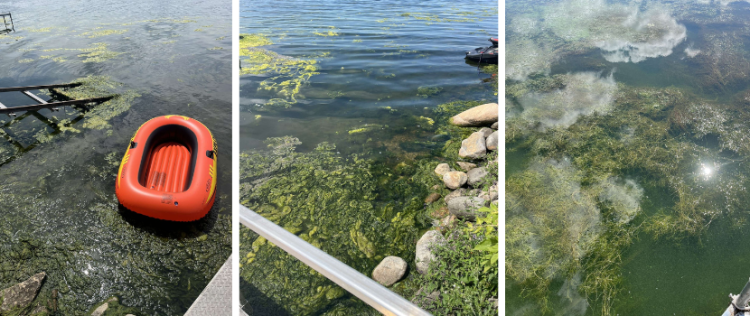
Denhyn Holowatuk, a graduate of the Agriculture and Food Production diploma program, first encountered algae at his family's cabin. He was often tasked with clearing it from the shoreline. Over time, he turned that chore into a small business, helping remove algae from other lakefront properties.
"I've always been the one to clean it up," he says. "I figured I could make it a business instead of just doing it for my parents."
That work continued into his capstone project, a final applied assignment in his program, where he began experimenting with ways to repurpose the material instead of sending it to landfill. His first focus was turning algae into fertilizer. While that approach showed promise, scaling it proved difficult. When the opportunity arose to explore algae as a biofuel, he took it.
Now working with Sask Polytech's Sustainability-Led Integrated Centres of Excellence (SLICE) in the Faculty of Technology and Skilled Trades, Holowatuk is testing how algae can be fermented and distilled into ethanol. His work recently received national recognition through the Wawanesa Climate Champions Youth Innovation Grant, delivered in partnership with Canadian Colleges for a Resilient Recovery (C2R2), supporting projects that turn environmental challenges into practical climate solutions.
In SLICE's Energy and Resources Lab, Holowatuk and research chair Graeme Drysdale worked with a biofuel panel that uses controlled heating to separate ethanol from the fermentation mixture. Because ethanol has a lower boiling point than water, it vaporizes first. The vapour is then cooled and condensed into a liquid which collects in a holding system for later fuel testing.
When the system didn't perform as expected with the fermented algae, they collaborated to troubleshoot, evaluating each component and testing solutions.
That experience became the foundation for everything that followed. Holowatuk has since developed his own small-scale setup, adapting the original biofuel design using readily available materials. Sourcing components from hardware and winemaking suppliers, he rebuilt the distillation system to better suit his needs and continue experimenting.
"It's basically the same process as making beer or vodka," he explains. "You ferment the material, then distill it, but instead of grains, you're using algae."
Equipment challenges meant starting over more than once, rethinking designs and finding practical solutions. Those moments, he says, were where the most learning happened.
"I've gained practical, hands-on experience working on this project, he says. "You run into problems and you just have to figure them out."

Even harvesting the algae has required creativity. Because it holds so much water, it's heavy and difficult to transport especially on steep lakefront properties. To improve efficiency, Holowatuk designed a simple system to remove excess water onsite before hauling it away.
The project offers a new way of thinking about the challenge of algae buildup in lakes. Algae blooms are common in many waterways and are often linked to nutrient runoff from surrounding land. While algae are a natural part of aquatic ecosystems, excessive growth can impact water quality, recreation and aquatic life.
For Holowatuk, that challenge is also an opportunity.
"There's so much of it and it's just being treated as waste," he says. "If you can use it for something, that's a win."
At the same time, he recognizes there are still questions to answer. The long-term impact of removing algae is being explored through ongoing conversations with environmental experts and watershed organizations.
"There's still a lot we need to learn," he says. "We're looking at what makes sense and where it's appropriate to do this work."
For Drysdale, the project is an example of how applied research creates meaningful learning and career opportunities.
"He's taken this on and is running with it," Drysdale says. "That's what applied research is about students taking what they've learned and using it to solve real problems."
The project is still in its early stages, with trials planned to determine the most effective way to produce fuel. Holowatuk will continue refining the process over the coming year, building on what he's already developed through hands-on experimentation.
The timing of future trials will depend in part on seasonal conditions and available materials. With a later start to the season this year, Holowatuk is still waiting for algae levels to build on the lakes he services through his shoreline cleanup business.
For Holowatuk, the experience has changed how he approaches learning and problem solving. What started as a side job has grown into a project that bridges agriculture, environmental science and energy, opening the door to new possibilities.
"If you're thinking about applied research, just give it a try," he says. "You learn so much by actually doing it."
Learn more about SLICE and Applied Research at Sask Polytech.
For more information

400 - 119 4th Avenue South
Saskatoon Saskatchewan
Canada S7K 5X2
www.saskpolytech.ca