


Lethbridge Polytechnic's Mueller Irrigation Research Group (MIRG) has developed an easy-to-use, web-based program to measure evaporation and transpiration (evapotranspiration, or ET) in agricultural settings, primarily crop and hay fields.
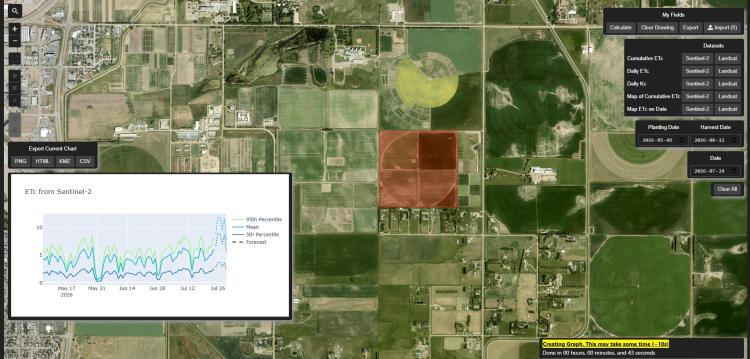
"Evapotranspiration is a major component of the water cycle, part evaporation which is a physical process and part transpiration which is when plants emit water vapour from their leaves as they photosynthesize." says Dr. Michael Kehoe, research scientist, Mueller Irrigation Research Group. "Measuring ET is important to determine soil moisture levels, giving producers, agronomists and researchers the information they need to make decisions on irrigation duration, amounts and more."
The program, called Irrimap, uses publicly available data to show ET amounts for selected areas, from small hectare fields to whole sections. Funded in part by Agriculture and Agri-Food Canada (AAFC) as part of Evan Derdall's research work, as well as through AAFC the Saskatchewan Ministry of Agriculture via the Sustainable Canadian Agriculture Partnership, Irrimap collates data into an intuitive and understandable format, giving the user valuable insights into crop water usage from a phone, laptop or other device.
"The importance and value of precision agriculture is growing as input costs increase, driving down margins for producers," says Dr. Willemijn Appels senior research chair, Mueller Irrigation Research Group. "Irrimap is an important tool that can be used to optimize growth and crop potential through variable rate irrigation and other precision, data-based technologies."
"One of the exciting benefits of Irrimap is that it is feeding into other tools we're researching and developing, like crop input optimization tools," adds Kehoe. "Projects like these ensure data-backed decisions are made that better manage inputs to minimize risks to yield."
A key member of the Irrimap team is Derian Setoguchi (Computer Information Technology 2025), who started with MIRG as an intern last year. Now a research assistant, Setoguchi coded and programmed Irrimap using skills he learned in the classroom.
"Irrimap was my first big project with technologies that I was unfamiliar with," says Setoguchi. "I was able to apply a lot of what I learned in CIT to work through the problems I encountered, like optimizing code and understanding the math behind the project. Between this and my other projects for MIRG, I've learned how much skills transfer between projects, both educational and professional."
Irrimap is available for public use and can be accessed at www.irrimap.ca.