


When Michael Hart left the Canadian Armed Forces, he didn't picture himself in a virtual reality headset diagnosing pneumonia. Yet that's where the former soldier found himself after enrolling in the University of New Brunswick's accelerated nursing program in Moncton.
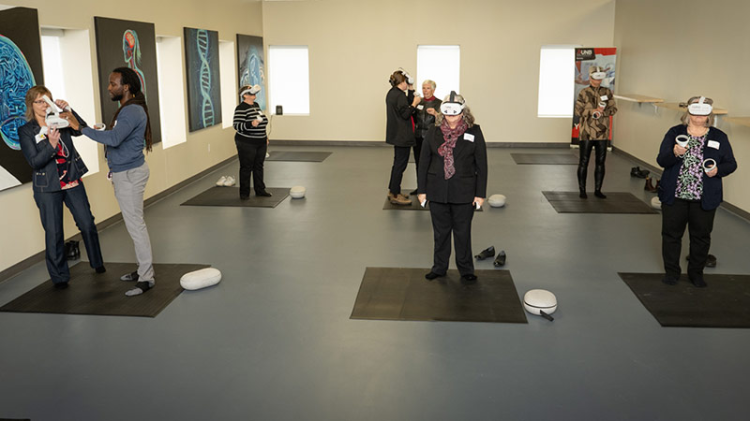
Guests at the Moncton site's 30th anniversary open house experience virtual reality headsets.
"I don't believe in fate, but it is hard to describe any other reason," Hart said of his decision to join the program after three years at Mount Allison University.
"As a mature student with a family, I must be as frugal as possible with both time and money. Time is money, and by attending nursing at UNB's Moncton site, I save a considerable amount of time."
UNB Moncton site's early years
When UNB's Moncton site first opened in September 1995, it offered a four-year degree program. Back then, two faculty members taught 24 students in a borrowed space next to the Moncton Hospital.
"We were expecting 12, and we had 24," said Dr. Monique Mallet-Boucher, one of the original two faculty members and retired program director who helped launch the site.
"The biggest challenge was transitioning into the clinical setting but the integration was successful," she said.
"Nursing education doesn't just happen in classrooms and nursing labs. It also happens in the various clinical settings where nurses work. Nurses who work in institutions and in the community are vital to the process of nursing education," she said.
The site was born from a national shift toward requiring a bachelor of nursing degree as the entry-to-practice standard. Diploma schools were closed. UNB, which had offered the degree at its Fredericton campus since 1959, expanded to meet the demand.
In 2013, the site moved from its original home into its own building on Lutz Street. In 2015, it adopted the advanced standing program now called the accelerated program designed for students with prior university degrees or credits.
A fast track for nurses
Today, the Moncton site offers only the accelerated program: six terms over two years, with a break in August. Students arrive with a degree or at least 46 credit hours, including anatomy, physiology, microbiology, pathophysiology and statistics.
"People are sometimes like, Oh, two years, that's not going to be anything.' But when they get into it, it provides a challenge," said Claire Williams, acting associate dean and associate teaching professor.
The workload is intense and clinical placements remain essential. Hospitals are busier than ever and there is a growing demand for qualified instructors. These challenges, along with the need to prepare nurses for increasingly complex care, have led UNB's faculty of nursing to embrace technology.
Simulation and VR: 'A huge evolution'
Inside the Moncton site are high-tech mannequins, operator rooms and a virtual reality lab where students tackle scenarios from morphine overdoses to tracheostomy care.
"On simulation days, instead of going for an eight-hour clinical shift, they come here for four hours and do four different simulations," said Renée Gordon, teaching professor and simulation strategist.
"Simulation is so impactful that it counts as double time."
The program runs more than 100 simulations a year, covering pediatric emergencies, dementia care and postoperative complications. Each session ends with a structured debrief.
"We talk about their emotions, what went well and what didn't, and what they would do differently in practice," Gordon said.
Hart said simulation is the "recreation of a life-like experience that permits students to utilize theory safely and practically."
His first simulation was pediatric tracheostomy care. Later came VR scenarios, which mimic real-world unpredictability.
"Making students recall critical information in a time-sensitive scenario helps to solidify fundamental skills," he said.
Technology also powers UNB's Learn Where You Live program, which lets licensed practical nurses earn a nursing degree without leaving home. Students receive VR headsets for theory courses and complete clinicals locally.
The model has expanded to rural New Brunswick and even the Yukon, where UNB has partnered with the government of Yukon and health facilities to "home-grow" registered nurses.
For Williams, it is a transformative shift.
"Nursing education hadn't changed much for 60 or 70 years," she said. "The introduction of simulation is a huge step forward. We can control what students are seeing and offer it in a safe environment. Errors are going to happen, so what we like to do is create safe places for people to make mistakes."
National recognition
In November, UNB's faculty of nursing won two national honours at the SIM Expo in Montreal.
The faculty received the SIM Innovator Award for its multi-modal strategy integrating VR, extended reality and high-fidelity simulation. Gordon earned the SIM Citizenship Award for her leadership in developing that approach and launching Learn Where You Live.
"We're shifting our mindset to see simulation not as an add-on, but as the backbone of clinical education," she said.
Those accolades underscore how far the Moncton site has come since its modest start 30 years ago, and where it's headed.
"Our triumphs have been the successful integration and the strong partnerships that the faculty has developed with community agencies and clinical settings," said Mallet-Boucher.
"The delivery of high-quality education has certainly been a trademark of the Moncton site and has been since the beginning."
A celebration of excellence
Moncton's 30 years of excellence in nursing education were celebrated on Nov. 26 with an open house, which included a tour of the simulation and virtual reality facilities.
"Our Moncton site continues to shape the future of nursing education by driving innovation, access and results, and delivering quality education," said Dr. Paul Mazerolle, UNB president and vice chancellor, in his remarks to gathered dignitaries including faculty past and present.
"This is a special milestone."
Dr. Lorna Butler, dean of the faculty of nursing said that while the Moncton site may be small, it is "powerful and impactful."
"We have a powerful team of individuals in Moncton. They very quietly go about what they're doing, and then you see a major impact."