Research X'cellence: Our StFX community levering expertise on today's most pressing challenges. At StFX, innovative research and creative activity are benefiting our communities, addressing some of today's most pressing challenges. Research X'cellence shines a spotlight on members of our inspiring educational community and the impact they're making. (To see the full series, please click HERE.)
Dr. Arlinda Ruco: Working to help prevent colon cancer
Dr. Arlinda Ruco still smiles as she relates the story of how a colleague once told her: "every time I see you, I think of colon cancer screening." For Dr. Ruco, those words, that awareness, are critical.
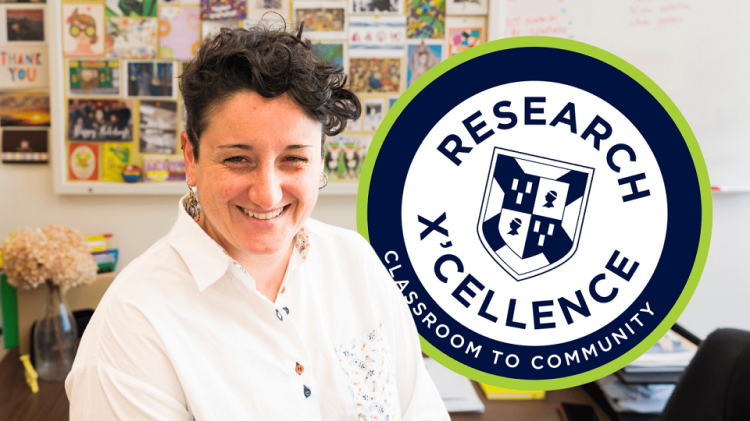
Dr. Arlinda Ruco
Almost every single person will be affected by cancer in their lifetime in one way or another," says the StFX interdisciplinary health professor and leader in the cancer screening and prevention field, whose research focuses on ways to promote colon cancer screening.
"Cancer screening allows us to prevent the disease altogether or diagnose it in the early stages when treatment may be more effective.
"If we can motivate just one more person to screen, to me that is a huge success."
Screening participation in Nova Scotia remains suboptimal, even though Atlantic Canada has some of the highest numbers of colon cancer, one of the most common cancers in Canada. Dr. Ruco want to change this.
"The main reason to do the screening is to try to prevent cancer. If traces of blood are found in the stool sample, it indicates a need for further testing. This can detect polyps, which can be removed, not allowing those polyps to grow into cancer," Dr. Ruco says. "It can also help us detect the disease at an earlier stage, which means treatment can be much more effective. And it also helps reduce costs for the health care system."
Dr. Ruco is the recipient of over $6.4 million in research funding. This includes a Canadian Cancer Society Emerging Scholar Research Grant where she is leading a team working to identify barriers to screening as well as to identify whether certain groups may be less likely to participate in colorectal cancer screening. She is also working on co-designing interventions to improve uptake.
Part of her research team is a patient/community advisory group.
"I have been really lucky. I have a patient and community advisory group made up of people who have/had cancer or are in the screening age group. This group has been critical, informing all the projects in my lab. They provide valuable feedback. They're part of the team when we apply for funding, and they're helping move this work forward.
"Working closely with our patient advisory group makes this very rewarding."
Dr. Ruco says she is also grateful to work closely with the Nova Scotia Colon Cancer Prevention Program (NSCCPP). They send a screening kit in the mail every two years for people aged 50-74.
"It is mailed to your address just before your 50th birthday and then every two years after. People take a sample of their stool at home and mail that back," she says.
"There are a few reasons people don't do it. They forget about it, they think they don't need it because they feel fine, and there's a yuck factor. But it's important
"One of the areas I want to expand into next is to address this yuck factor," she says.
To address this, Dr. Ruco is looking to collaborate with the StFX Department of Engineering to see if they can come up with some sort of device to facilitate the collection of the stool sample that would take away some of the yuck factor.
She's currently also researching the role social media could play in increasing awareness. In collaboration with those in the screening age range, Dr. Ruco and her team have created sample ads promoting colon cancer screening. They then tested the ads through a randomized controlled trial and are now analyzing data on which ads performed best online.
"Social media is an important tool to explore as people spend so much time on it," she notes.
The more we talk about it as well, the more it breaks down that stigma and increases awareness and hopefully participation in screening.
Dr. Ruco and her team are also studying primary care interventions, having previously interviewed doctors and nurse practitioners who are doing a great job at getting people to screen, particularly with marginalized populations. The study looked to understand what these primary care providers are doing that's effective, and what we can learn and use from their experiences.
They're also speaking with three under screened communities, including immigrants, African Nova Scotians and 2SLGBTQI+ to learn more about any barriers. Dr. Ruco wants to gain insight into what might be stopping them from screening and how to address these barriers.
"For me, it's about screening that is accessible and easy to do for every single one of us," she notes on the work.
Her research also focuses on women and women's health. She is conducting a study of women across Canada who have been diagnosed with colon cancer before age 50 to learn more about their experience with the healthcare system and the potential for delayed diagnosis due to their younger age.
"There have been some interesting learnings on how we can improve the experiences of younger women who are diagnosed with colon cancer," she says.
Part of those learnings include the need for more information on how cancer treatments can affect fertility and more discussions and education about how a colon cancer diagnosis may impact sexual health and intimacy. This research also advocates for lowering the screening age, as has been done in some other jurisdictions.
Next on her agenda is a plan to study screening patterns. Some people consistently screen. Others never do. Dr. Ruco is particularly interested in studying the third category, or inconsistent screeners. She'd like to dive into who is most likely to be an inconsistent screener to understand what's informing their decisions. This data would be useful to share with screening programs to see what targeted interventions they can do.
Dr. Ruco's interest in colon cancer research started about 12 years ago while she was doing her Master's in Public Health and working with a team of scientists and clinicians focused on this area. When she started her PhD at the University of Toronto Institute of Health Policy Management and Evaluation she decided to continue to focus on this research.
With cancer being such a prevalent, pressing issue in society she really liked the idea of trying to prevent the disease. "For me, the prevention piece really made me stick with it."
As a faculty member at StFX, Dr. Ruco finds it gratifying to now take on that mentor role herself, working with those future scientists who bring fresh ideas, and help them grow. This year, she is supervising four undergraduate honours students.
"It makes you feel so fulfilled when you can ignite that passion. It's really amazing."
Dr. Ruco has already had an oversized impact since joining the faculty in 2022, where she teaches health leadership and introduction to health research methods. In three short years, she has won both the university's Outstanding Faculty Teaching Award and the President's Research Award.
She's also making a difference in her research efforts.
One example is an article she published in The Lancet Gastroenterology & Hepatology, one of the top journals in the field of gastroenterology and hepatology. It's framed and hanging on her wall. The research paper provided new data on the duration that patients remain at reduced risk of colorectal cancer incidence and mortality after a complete colonoscopy. It was featured on the cover of the highly esteemed journal and also received a Top 10 Honourable Mention for the Article of the Year Award from the Canadian Association of Health Services and Policy Research. But beyond that, to Dr. Ruco, it speaks to the impact the research can have.
"That one is special," she says.
"It's a good reminder of why we do what we do, of the impact of our work."