


Most university students know the feeling: Too much to do, not enough time - and a phone that's hard to put down.
Many are juggling classes, jobs, long commutes and family responsibilities - struggling to focus, or exhausted before the semester is halfway through.
But when students in professor Deena Kara Shaffer's Learning and Development Strategies class started tracking their screen time, many were surprised by what they found.
"Students will say they don't have enough time, but when they check their phones, they might see four, five or even six hours a day on social media. The time is there, but it doesn't feel spacious."
Shaffer's class, often called the "how to learn" course, blends academic learning strategies with practical tools for well-being and academic resilience.
"I want students to reclaim some of that precious time," says Shaffer. "Not for efficiency's sake, but so they can learn in ways that actually feel sustainable."
And the results have been significant. Students who have completed the course report improved grades and well-being, along with reduced procrastination, overwhelm and exhaustion.
The impact recently earned Shaffer a Dean's Teaching Award, recognizing the positive effect of the course on student learning and success.
"My mission is to get learning strategies into the hands of every student," she says. "Because if students know how to learn, the ripple effects are extraordinary."
A course designed with students
Learning and Development Strategies was originally co-developed by Shaffer and Diana Brecher, a Clinical Psychologist from the Centre for Student Development and Counselling, originator of ThriveTMU, and scholar in residence for Positive Psychology, who were also co-founders of the Thriving in Action program.
Brecher brought expertise in Positive Psychology and CBT; Shaffer focused on learning strategies and study skills. Together, they started with a small pilot course that grew into an open elective available to students across TMU.
"If you teach students how to face the hardest parts of school," Shaffer says, "like a bad mark, a confusing assignment or an overwhelming schedule, something powerful happens."
After the pandemic, Shaffer realized that students' lives looked different. Their challenges had evolved, and the course needed to evolve with them.
So she invited former students back to help redesign it.
Last summer, several students who had previously taken the course returned as curriculum co-designers. They worked with Shaffer to rethink assignments, reshape lessons and ensure the course reflected the realities of student life today.
"Students were telling me their lives are different now," she says. "So we rebuilt the course together."
Each semester, new student co-designers help refine the course again, keeping it closely tied to what students actually need.
"They get to pay it forward to the next cohort," Shaffer says. "And I get to keep my finger on the pulse of what students are really experiencing."

Deena Kara Shaffer (right) and Diana Brecher (left) co-created Learning and Development, a course that blends learning strategies and positive psychology to support student success.
The Unplugged Challenge: a semester-long reset
At the centre of the course is a semester-long series of experiences and experiments that lead to a capstone called, "Integration."
Over the semester, students complete six two-week experiments designed to help them reset their habits and improve how they learn.
The first focuses on sleep - Shaffer encourages students to build consistent sleep routines from the beginning of the semester. Next comes movement, with students gradually integrating physical activity into their days. Later experiments address community connection, campus involvement, collaboration, mindfulness and rest.
Only after those foundations are in place does Shaffer ask students to examine their relationship with their phones.
This includes the Unplugged Challenge, which runs in parallel to the course's capstone project.
Designed as a semester-long "digital reset," the challenge invites students to take a closer look at their relationship with their phones, technology and social media. While participation is voluntary, the challenge brings the course's holistic learning strategies to life, helping students build healthier habits that support both their academic performance and overall well-being.
"Students start to notice how often they pick up their phones," Shaffer says. "And they begin to ask whether that time is actually serving them."
The goal, she's clear, isn't about self-control, discipline or willpower.
"These apps are designed to keep us hooked," says Shaffer. "I just want students to see that clearly and reclaim a little bit of that time back."
By the end of the semester, students have built a personalized toolkit of strategies they can carry into future courses.
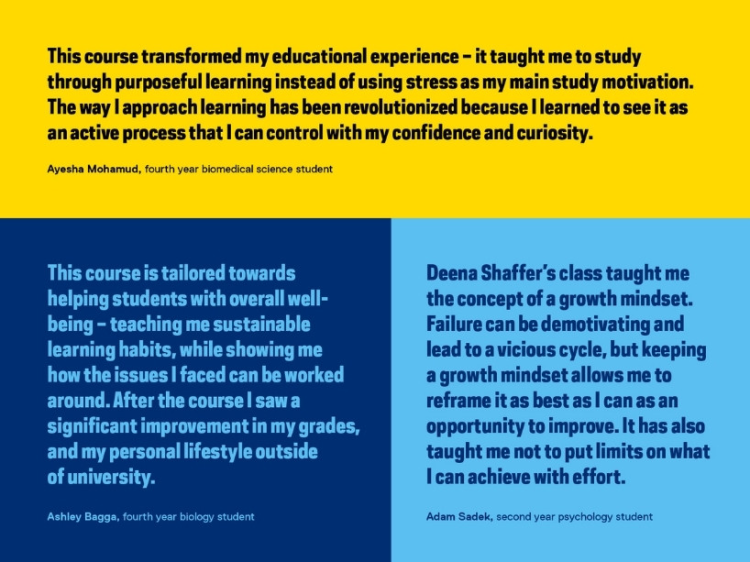
Student testimonials show the course's impact on learning, time management and overall well-being, both inside and outside the classroom.
"I want them to discover what makes learning feel good for them. When students find strategies that actually work for their lives, they begin to trust themselves as learners."
A national conversation about screen time
Concerns about youth screen time are growing across Canada.
In January, Rogers Communications announced Screen Break, a $50-million initiative focused on helping young people build healthier relationships with technology. The program includes a partnership with TMU policy thinktank The Dais called "Heads up", exploring solutions to rising screen time among teens.
Those efforts reflect a wider national conversation about digital well-being - one that's also happening in TMU classrooms.
Shaffer's course allows students to experiment with healthier habits in real time, while learning strategies they can carry with them throughout their academic and professional lives.
Shaffer is also developing a new training program for educators called Awakened Learning. Incubated at TMU's Social Venture Zone, the initiative aims to launch the world's first Holistic Learning Strategist Certification, equipping educators with evidence-based tools to transform how students learn, feel and thrive.
"School doesn't have to feel like suffering"
For Shaffer, the message at the heart of the course is straightforward.
Students often arrive at university without ever being taught how to learn - but those skills can change everything.
"Learning strategies are where academic performance, mental health and equity meet," she says.
When students build those skills, she believes the impact goes far beyond the classroom.
"It can still be hard. It can challenge you. It can push you," says Shaffer. "But school doesn't have to feel like suffering."
Learn more about Shaffer's Learning and Development Strategies course on the course website.