


Arish Shahab and Aaron Yu, both in McMaster's Integrated Biomedical Engineering & Health Sciences (iBioMed) program, and Mechanical Engineering student Ramin Syed are the founders of Amano, a startup developing radically affordable hearing devices. Their goal: Make hearing care accessible to people who have long been priced out of it.
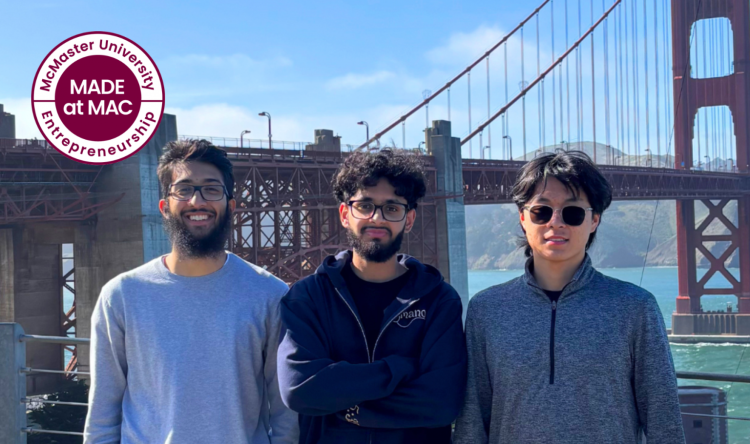
McMaster students and Amano founders, from left, Ramin Syed, Arish Shahab and Aaron Yu worked with accelerator Founders Inc. in San Francisco on their low-cost hearing device, which has gained international traction.
A problem close to home
The idea for Amano wasn't born in a lab it emerged from lived experience.
Between them, the three students had multiple family members affected by hearing loss from a sister diagnosed at birth to grandparents gradually losing their hearing.
"We saw that people were being prescribed solutions, but not necessarily able or willing to actually get them," says Shahab. "If you're living day-to-day, you might not realize how much hearing loss is affecting you until it gets worse."
As they began digging deeper, they uncovered something striking: Hearing loss is both widespread and often untreated and left unaddressed, it can contribute to more serious conditions, including cognitive decline.
Their academic experience helped shape how they approached the problem.
In their second-year anatomy course, Shahab and Yu studied the structure and function of the ear in detail. One insight stood out: The ear itself is fundamentally mechanical.
"That changed how we thought about the problem," Shahab explains. "We realized you could approach hearing care in a completely mechanical way rather than relying on complex electronics."
That idea became the foundation for Amano.
Instead of building a traditional electronic hearing aid, the team set out to design a purely mechanical device one that could dramatically reduce cost while remaining functional for people with mild hearing loss.
While the average hearing aid can cost upwards of $4,700, the students' custom-fit hearing technology costs $20, and can be built in under 10 minutes. While the devices are not intended to offer the same level of performance as traditional electronic hearing aids, they can bridge the accessibility gap for millions of people.
Building from scratch outside the classroom
Over the course of several months, the students moved from concept to prototype through rapid, hands-on iteration, starting with simple models and refining them through user feedback.
Early conversations with people experiencing hearing loss helped shape the design. Many shared frustrations with existing over-the-counter devices, including poor fit and unnatural sound quality.
In response, the team focused on customization. Amano's devices are designed to be tailored to individual users, with 3D-printed outer components that match the shape of each person's ear.
"We designed the product to break the stigma around hearing aids, tearing down every barrier so people can hear their families again," says Syed.
Their momentum accelerated earlier this year when they applied to Founders Inc., a San Francisco-based hardware accelerator.
Filming their application video in Mills Memorial Library, they pitched Amano as a fundamentally different approach to hearing care - one rooted in simplicity, accessibility and mechanical design.
They were accepted. Just days after finishing final exams, the team flew to California to join the six-week program, working out of a 42,000-square-foot facility alongside founders from around the world.
There, they received hands-on mentorship in everything from product development to fundraising and go-to-market strategy.
"It's really about going from zero to one," Shahab says turning an idea into a real company.
Learning at startup speed
For Yu, the experience has revealed the complexity behind building a health-care product.
"You don't realize how much goes into developing a medical device until you're doing it," he says. "Regulation, approvals, safety there are so many layers."
The team is currently navigating those realities firsthand, working through regulatory requirements in both Canada and the United States and preparing for broader deployment.
"For example, in Canada, we are a Class 1 device - we're the ones who make and distribute the device and we've obtained our Medical Device Establishment Licence," says Yu.
At the same time, they've taken on clearly defined roles within the company: Shahab leads operations and strategy, Yu focuses on software and customization systems, and Syed heads mechanical design.
A viral moment and growing demand
During their time in San Francisco, Amano has gained international attention.
A video shared by Founders Inc. showcasing their work quickly went viral, drawing millions of views and sparking widespread interest in their approach to affordable hearing care.
The response translated into tangible momentum: the team has already received roughly 1,300 pre-orders for their device.
With early validation in hand, the founders are now focused on scaling.
They are preparing for fundraising, finalizing a patent, and exploring options to build out their own manufacturing space. But their immediate priority is delivering devices to the people who have already placed orders.
Throughout their journey, the students say their experience at McMaster has been central from foundational coursework to mentorship and community support.
"We have a tremendous ecosystem of innovation here at McMaster University. In particular, we have a unique collaboration between the Faculty of Health Sciences and the Faculty of Engineering with our iBioMed Program," says Michelle MacDonald, co-director of the program and an associate professor at McMaster.
"Arish and Aaron shared their device with me in the fall and have since found success at an accelerated pace. It is so impressive that they have balanced their studies and extra-curricular activities with starting this business venture," she adds.
Both faculty and alumni in the Health, Engineering Science & Entrepreneurship (HESE) degree of the iBioMed program have helped connect the learners with other founders and provided guidance as they navigated unfamiliar territory.
"It's been really helpful to learn from people who have done this before," Yu says.
At its core, Amano reflects a broader shift among students one where learning doesn't stop at the classroom door.
By applying engineering, medical knowledge and entrepreneurial thinking to a real-world challenge, Shahab, Yu and Syed are working to close a gap that affects millions.
And as they continue building from San Francisco to Hamilton and beyond, their focus remains clear: making hearing care more accessible, one device at a time.