


When her feet hit the water for her first coached swim, eight-year-old Hannah Burns thought, "this must be what flying feels like."
"Swimming to me means freedom. No special equipment, no barriers. Just me and the water and how fast I can go," she said.
Today, as a high-performance athlete and a swim coach, Burns wants to make sure other kids and families don't have to rely on word-of-mouth, as she did, to find parasports opportunities that bring them joy.
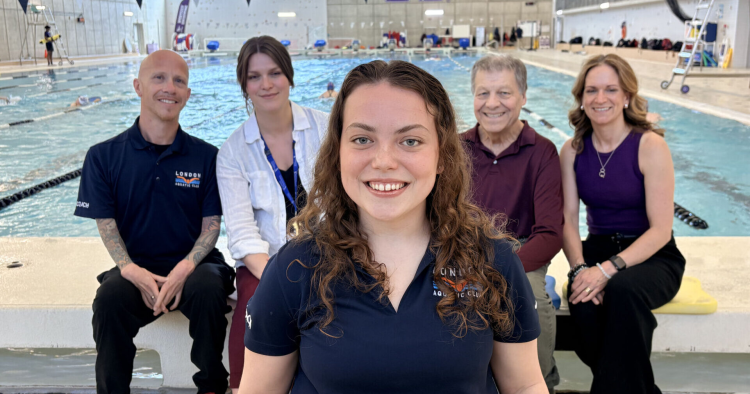
Mobilizers of a new network for athletes and sports participants, including (L to R) PhD candidate Adam Purdy, Stephanie Marrocco of St. Joseph's Health Care London, swimmer Hannah Burns, Dalton Wolfe of St. Joseph's Health Care London and Western professor Laura Misener. (Debora (Flaherty) Van Brenk/St. Joseph's Health Care London Communications)
"A lot of opportunities are out there but they need to be widely available and visible. Sport is so important for everyone's developmental path whether you're born with a disability or acquire one later in life. Sport challenges you and gives you a community in a deeper way."
Burns is among several sports enthusiasts who - with St. Joseph's Health Care London (St. Joseph's) and Western University as catalysts and sustainers - have created a unique-in-Canada network of London-based groups and advocates involved in parasports and physical activity.
'One-stop' resource for athletes and advocates
AdaptAbility London aims to build local support, connection and community through sport and exercise for people with a disability.
Its website, AdaptabilityLondon.ca, provides contact information for specific sports; is searchable by season, sport, venue and time; and is also a portal for volunteering and other resources.
Site visitors could learn, for example, that boccia takes place on Wednesdays, adaptive climbing monthly at The Junction, wheelchair basketball Thursday evenings, goalball on Fridays and fitness activities for people with physical and/or intellectual disabilities most weekdays at Hutton House.
Until now, that was information you might find - if you found it at all - by scouring the internet, scrolling through social media pages or by word-of-mouth.
"This is a one-stop shop in the London area," said Stephanie Marrocco, research coordinator at St. Joseph's Parkwood Institute.
Marrocco says the network is new but gaining momentum.
"Everyone is very passionate about what they do, so everyone wants to see their program succeed and grow."
Network participants include athletes and adaptive sports organizations, along with co-founders Marrocco, Western kinesiology professor Laura Misener, Lawson Research Institute scientist Dalton Wolfe and Western psychology professor Dr. Blair Evans.
Shared expertise and leadership
"Many of these groups don't have any other way of getting connected so getting them together was the first big task. And then, because it's their network and not ours, the next question we asked was, what are your needs?'" said Misener, who is also Western's Dr. Frank J. Hayden Endowed Research Chair in Sport and Social Impact.
We're facilitators of the network, but we co-create the solutions with athletes, organizations and participants. It's shared expertise, shared leadership," added Wolfe.
For sport organizers, needs often include: resources to train, retain and sustain volunteer engagement; advertising and awareness; collective advocacy; finding fully accessible sports venues; and brainstorming sustainable funding models.
Participant needs include building social connections with peers and finding information on sports specific to their interests, preferred schedules and seasons.
Adam Purdy, a Canadian Paralympic swimmer, coach and Canadian Paralympic Committee member whose PhD studies focus on participation in accessible sports, says the network benefits everyone, from participants to high-performing competitors to the people who support them.
"Sport is what nourishes a culture. We need it for healthy communities and it should be accessible to all. Every body deserves to experience it." - Adam Purdy, PhD candidate in kinesiology
There isn't another network like this in Canada.
Calgary Adapted Hub powered by Jumpstart is similar to AdaptAbility London but is aimed at children and youth, not adults. ParaSport Ontario provides information about more than 30 sports accessible to people with disabilities but doesn't sort by calendar or include sports specific to people with intellectual disabilities.
"We all have common needs, including the need for connection," Misener said. "I sometimes think there's a false dichotomy between high performance and participation."
Misener believes in the importance of valuing self-determined physical activity and creating pathways for all these opportunities across the lifespan.
"If you want to do yoga twice a week, that's great. And if you want to pursue a high-performance route, we need to make sure these opportunities are also available."