

Studying the humanities and social sciences, though, gave her a sense of belonging - and proved to her that the things she cared about, like people, identity, belonging and culture, were also things that were intellectually valuable.
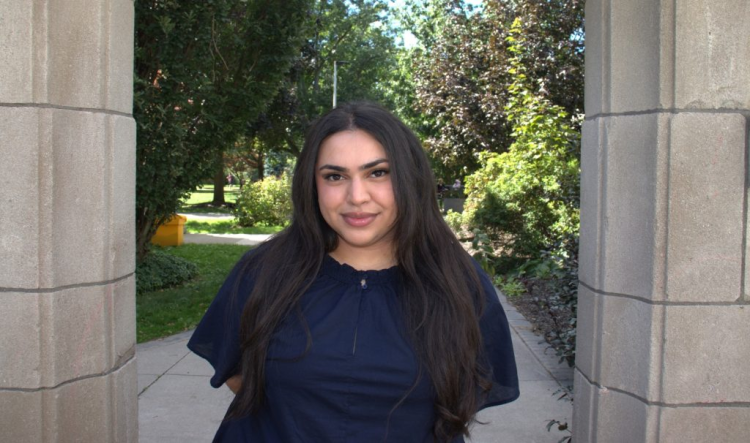
Banmeet Sangha, a third-year student in the Global Peace & Social Justice and Society, Culture, & Religion programs, and one of five winners in the Magna Charta Observatory's 2026 international essay competition.
It was those ideas that Sangha, a third-year student in the Global Peace & Social Justice and Society, Culture, & Religion programs, wrote about in her entry for the Magna Charta Observatory's 2026 international essay competition.
And it was those ideas that inspired the judges to select her essay as one of five winners of this year's competition, out of 228 submissions from 44 countries.
"After the initial surprise of finding out I'd won, I felt incredibly grateful and also proud - the themes I wrote about were definitely things that I'd struggled with for a long time," she says. "Having the piece recognized was really validating for my own definition of intelligence and concepts around belonging in higher education."
Here, Banmeet shares more about the influence of growing up in a diverse community in Brampton, the importance of being involved in activities outside of the classroom, and how felt to find out she'd won.
Tell me a little bit about yourself.
I'm in my third year of combined honours in Global Peace and Social Justice (GPSJ) and Society, Culture and Religion. I was raised in Brampton, Ontario, as the daughter of two immigrants from Punjab.
Growing up in such a diverse community strongly shaped the way I see the world - meeting people from so many different paths through life, who bring so much different kinds of knowledge to the table, taught me a lot about what it is to actually understand and learn from others.
There's a lot you can learn from people who are similar to you, but there's a lot more to learn from people who have differences.
I love being involved in the community and contributing to the spaces around me, whether that's at school or in the broader community.
What was the theme of your winning essay?
The main theme was how studying the humanities completely changed my understanding of intelligence and my relationship with education.
Growing up, I had internalized the idea that being smart meant excelling in subjects like math or science and arriving at one correct answer. Since those subjects didn't naturally come to me, I often questioned whether I was capable of succeeding in higher education.
The humanities were the first place where the questions I naturally cared about, questions about people, identity, culture and justice, were treated as intellectually valuable.
The humanities also gave me a sense of belonging in academia. As the daughter of Punjabi immigrants, I spent a lot of time thinking about identity, migration, belonging and what it means to exist between cultures. I began to understand that these weren't just personal experiences, but questions that could be studied in relation to larger structures.
How did you feel when you found out you won?
I was shocked. I knew how meaningful the piece was to me because so much of it was about myself, but I didn't expect it to resonate with other people. Finding out that I was one of only a few students selected internationally felt incredible.
The prize involves an adventure - can you tell me about that? What's it like planning a trip that big?
I'll be travelling to Sydney, Australia, later this year to participate in the Equity Practitioners in Higher Education Association conference. The support I've received from the global experience office in the Student Success Centre has been really helpful, especially since this is my first time navigating an international experience like this on my own as a young adult.
They've helped me better understand what I need to consider before leaving the country, the steps I need to take to prepare, and where I can go for guidance when I have questions. Having that support has made the process feel much more manageable!
What inspired you to pursue your programs?
I entered Humanities without knowing what I wanted to major in.
I spent my first year taking a mix of courses - and being able to do that was a big part of why I chose McMaster! During first year, I realized I kept gravitating toward courses that dealt with questions about people, identity and the ways inequality manifests in our world.
I was especially drawn to Global Peace and Social Justice because it forced me to think critically about issues I was already passionate about, including conflict, inequality, human rights and social change.
Society, Culture and Religion helped me explore culture, identity and religion, and understand why things happen beyond just the facts of them happening.
The two majors are very related. In a way, one tells me more about what's happening, and the other tells me why it might be.
You've been the president of the Global Peace and Social Justice Society, and you've also been involved with Welcome Week planning. What are the good things about being involved with things outside of class?
Being involved has always been as important to me as academics - I didn't always excel in everything academically, so this was a space where I felt I could excel.
Everything that I've been involved with here at Mac has pushed me to step outside of my comfort zone, and has given me the opportunity to meet people who care about the same issues I do, but who also bring completely different perspectives and experiences to those conversations.
The sense of community and belonging that I've encountered here has encouraged me to take on opportunities that I probably wouldn't have imagined myself doing.
What do you enjoy doing outside of school?
One of the things I enjoy most is giddha, a traditional Punjabi dance form that involves singing and dancing. I've been doing it since I was young, and it gives me a connection to my culture while helping me learn about my heritage, traditions, music and stories. I've also had the opportunity to teach dance to youth in Brampton. I grew up going to those classes, so getting to teach them was a really cool experience.
Who or what has been an influence on your life?
The biggest influence has definitely been my family. The way I was raised really shaped the way I go about my life, particularly my values, my work ethic, and the way I approach challenges.
Growing up, I learned the importance of working hard, because both of my parents worked to give me opportunities that they didn't have. My family has always been supportive of anything I want to try doing, and my determination and sense of responsibility come from the fact that I had a lot of independence when I was young.