


Faith is an important part of how some students understand themselves and the world around them, and they do not leave this part of their identity at the classroom door.
A new additional qualification (AQ) course offered by the University of Windsor's Faculty of Education aims to help teachers gain the knowledge and practical tools to better support Muslim students and respond to Islamophobia in educational settings.
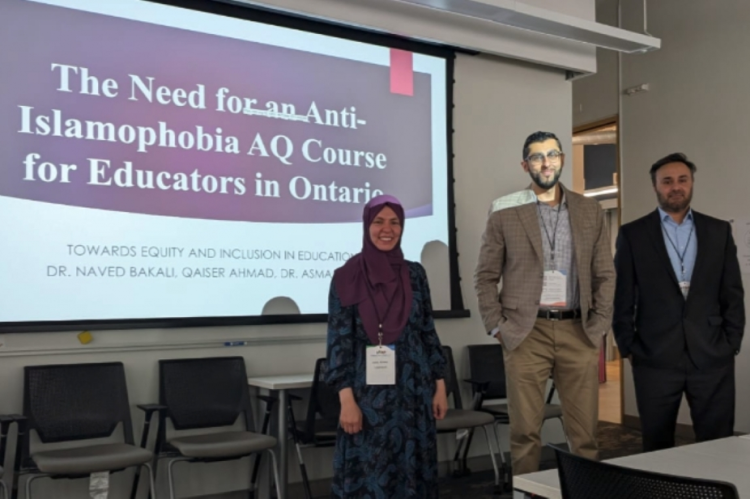
Drs. Asma Ahmed and Naved Bakali alongside TDSB principal Qaiser Ahmad have developed a new AQ course combatting Islamophobia in schools (PROVIDED BY A. AHMED/University of Windsor)
Safe and Accepting Schools: Affirming Muslim Identities and Countering Islamophobia will be the first AQ course of its kind in Ontario, with registration open now for winter 2027.
Co-designed by Dr. Naved Bakali, a professor in UWindsor's Faculty of Education, with Niagara University's Dr. Asma Ahmed and Toronto District School Board Principal Qaiser Ahmad, the course is grounded in scholarly research and the experiences of educators and Muslim communities.
The idea for the course arose when Bakali and Ahmed were working on a research project exploring pre-service teachers' experiences with Muslim students in southern Ontario public schools.
"Through this project it became abundantly clear that preservice and in-service teachers did not feel well-prepared to work with and teach Muslim students," says Bakali.
"In a survey of 555 educators, 93 per cent reported receiving no professional development on supporting Muslim students, while 95 percent expressed interest in such training and 97 per cent believed it would be beneficial," Ahmed adds.
Bakali further notes that findings pointed to a prevalence of miseducation and misunderstanding of Muslim students and their faith-based identities in public schools.
This research led them to develop the AQ course to help working teachers challenge anti-Muslim stereotypes and misconceptions.
"The notion of inclusion within schools often overlooks faith-based identities," Bakali explains.
"It's often assumed that inclusion of various cultural traditions or racial identities suffices. We felt that religious identities for some students are just as important as their cultural and racial identities and that there's a need for inclusion within this realm as well."
In building the course, Bakali, Ahmed and Ahmad collaborated, each leaning on their own areas of expertise.
"Asma [Ahmed] has done excellent work over the years in relation to understanding faith-based identities through the implementation of culturally and religiously responsive pedagogical approaches in schools," says Bakali.
"Qaiser [Ahmad] has done several workshops and training programs as an educational administrator. He was therefore able to develop modules and resources related to understanding Muslim students and the complexities of their identities within the public school system."
Bakali contributed his expertise in challenging Islamophobia and racism.
As Ahmed explains, Islamophobia goes beyond individual acts of prejudice.
"Assumptions, policies, curriculum, school practices and institutional structures can unintentionally marginalize Muslim students," she says.
She stresses that the course will help educators understand the diversity within Muslim communities and critically examine their teaching practices. The aim is to move beyond simply accommodating religion toward creating respectful and affirming learning environments.
"The course is intended to be practical," Ahmed says. "The goal is for educators to leave better equipped to create safe, inclusive and affirming learning environments for Muslim students while strengthening their broader capacity to teach across religious and cultural difference."
Ahmad hopes it will address some of the questions he has been hearing for decades in the school system, including when he was a student himself: "Where will Muslim students pray? They will miss part of the class if they go to pray! Why can't they pray at home? Why can't they swim while fasting in the month of Ramadan?"
"A foundational understanding of Muslims and Islam within an educational context can help school communities implement inclusive practices more effectively," Ahmad explains.
"It can also foster a stronger sense of belonging, which contributes to greater student confidence, well-being and engagement."
For teachers who may feel the course is not relevant to their classrooms, Ahmed suggests they think again.
"It is important that this work not be understood as relevant only to teachers who currently have Muslim students in their classrooms," she says.
"Learning how to recognize Islamophobia, critically examine institutional practices and respond respectfully to religious identity is part of the broader professional responsibility of educators working in increasingly diverse schools."
As Ahmad notes, "at one school where I worked, I established a multifaith prayer space. Although most of the students who used the space were Muslim, students from other faith traditions also used it for prayer and reflection."
"The space communicated an important message: students' well-being mattered, their beliefs were respected and their identities were affirmed," he continues.
"Such inclusive practices can strengthen students' confidence, sense of belonging and connection to their school community. Isn't that what educational institutions should be striving towards?"
The AQ course is just the beginning, as its developers continue their research on affirming Muslim students, including a planned book project to help guide teachers.
"One of the most exciting aspects of this AQ is the opportunity to move research into practice," Ahmed says.
"We know there are gaps in teacher preparation. Rather than simply documenting those gaps, this course asks what we can actually do about them and gives educators practical tools for creating schools where Muslim students, and ultimately all students, can experience greater safety, belonging and affirmation."