


For Dr. Ajwang' Warria, the realization came during the lead-up to the 2010 FIFA World Cup when nearly 400,000 visitors poured into South Africa.
Some visitors came with more than just soccer on their minds, and human traffickers across the region were ramping up their exploitation of girls and women in expectation of a huge windfall.
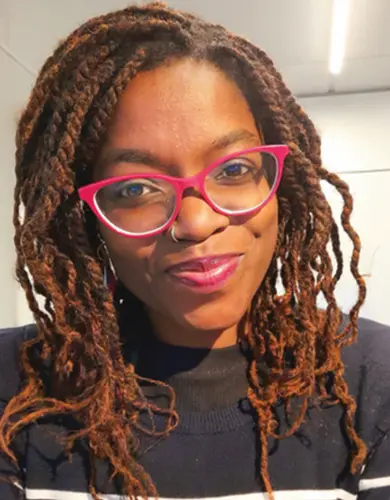
Ajwang' Warria / Photo Courtesy Ajwang' Warria
Warria, PhD, a former front-line social worker who had worked in child protection, was with an organization focused on stopping trafficking. Her job provided a lens that helped her see what she couldn't see before.
"That is when I got the words in terms of what human trafficking is," she says. "When I looked back, I would say that maybe 50-60 per cent of the cases that I had worked with as a social worker were actually child-trafficking cases.
"That got me thinking: How many cases fall in between the gaps because we don't have legislation or because it's not part of the social work curriculum, or it's not part of social work practice or any practice, for that matter?"
Warria, who joined the University of Calgary's Faculty of Social Work in 2022 and is now a University of Calgary Research Excellence Chair, says this realization changed her career trajectory. During her master's, she'd focused on researching unaccompanied child minors in transnational migration, but, with this newly acquired lens, she changed her doctoral study to researching child trafficking.
Developing South Africa's national legislation on trafficking
This new focus led Warria to tackle the issue at every level in South Africa, working on creating guidelines for social workers when they identified a child who had been trafficked. South Africa at the time had no anti-trafficking legislation, and the then-PhD student was gratified to become one of two researchers contracted to create a draft of the new legislation.
"It was nice to see the fruits of my work going to something like that," she says.
Warria also co-developed policy briefs for UNICEF, which took their work to the global stage.
"We also supported the UN Global Office, which is based in New York to develop a curriculum for social workers and paraprofessionals in countries where there are no social workers or where social work is not yet recognized," Warria says.
The 'invisible crime' happening in your and everyone's neighbourhood
Human trafficking in Canada is widely understood to be both significant and deeply under-measured. Between 2014 and 2024, police recorded just over 5,000 incidents, but, for the most part, experts, including Warria, stress that it remains a hidden crime shaped by fear, stigma and misidentification.
"There are so many people who are currently in a trafficking situation, but we just don't know the full extent," Warria says.
Warria says trafficking is under-reported for many reasons: It is dangerous, many victims may not be aware they're being trafficked, and some may fear being deported if they alert the authorities. Many are also exploited in private homes and workplaces where detection is difficult. She emphasizes that the very nature of trafficking makes it hard to quantify.
"Trafficking is one of those situations that just doesn't present itself," Warria says. "It's hidden; in fact, it's invisible a lot of times."
While police statistics often link trafficking cases to sexual exploitation and show most identified victims are women and girls, research increasingly suggests labour trafficking may be more common, but far less reported.
There is a complex and often contentious boundary between sex work and sex trafficking, Warria says, adding that debates about agency and rights can obscure exploitation.
"When somebody comes and tells me a 15 year-old has agency and they can choose to be a sex worker, I say, No.' They're being exploited and they're being prostituted," she says. "Nobody chooses to be exploited. It's just that circumstances force people to make very difficult choices about their lives."
A research chair focused on teaching, research and impact
In 2023, Warria's global research was recognized with a five-year, University of Calgary Research Excellence Chair focused on the intersections between human rights, migration and labour exploitation, and trafficking.
Her work examines the ways in which trafficking is interconnected with social vulnerabilities and structural inequities ranging from the individual to international levels. Warria recently co-developed and taught a new undergraduate social work course, Slavery, Exploitation and Human Trafficking, that includes front-line social workers and survivor-educators as guest speakers.
Warria says survivors are foundational to her work and hearing their stories informs the research while fuelling her passion to continue engaging and collaborating with them.
"The joy that I've seen is in working with survivors and what they have taught me, things I never would have learnt in a classroom situation," she says. "I like being able to step back and listen to their stories and listen to what they can teach us about doing this work in a way that is different, in a way that is a lot more meaningful."
The course introduces trafficking to the next generation of social workers who will frequently encounter the issue. Since trafficking and slavery is hidden and overlaps with other social issues (violence, substance use, child protection), it is often missed.
A second goal is to raise awareness of trafficking itself, because it can happen anywhere, including on university campuses, and it can include peer-to-peer trafficking and exploitation.
Understanding both sides of the trafficking problem
To fully understand the mechanisms and intersections of exploitation, human slavery and trafficking, Warria says her work is guided by the "Three Ps": Prevention, Protection and Prosecution, adding her goal is to understand both sides of the issue.
On the victim's side, she already prioritizes the voices of survivor educators. Warria hopes to expand her research to better understand how perpetrators go about committing this crime. Due to the challenging and perhaps dangerous nature of this work, it's an under-researched area that she considers essential in developing effective interventions.
A Calgary roundtable focused on stopping trafficking
There's an increasingly important fourth "P" among those working in anti-trafficking: Partnerships a principle that sits at the heart of Warria's role as research chair and as an Institutes for Transdisciplinary Scholarship co-lead for Cities and Society.
She is planning a Calgary roundtable that will bring together organizations working on trafficking to identify shared priorities, reduce duplication and strengthen co-ordinated responses across the city. The planned gathering will be a low-key affair and safety-focused, reflecting the reality that anti-trafficking work can be dangerous and that organizations and front-line workers must carefully manage how, when and which aspects of their work are made public.
Warria's future work will include a new international collaboration with two Kenyan universities that will be focused on exploitation and related issues in artisanal and small-scale mining communities.
Artisanal mining is a largely informal sector that supports millions globally, but, while mining sites provide income for families, they can also expose workers, including women and children, to hazardous conditions, economic precarity and, in some cases, labour exploitation and trafficking.
Warria says her project will explore how these vulnerabilities intersect with mental health, migration and community resistance, particularly now as governments are planning to lease some of these sites to international companies for large-scale mining operations, which, she says, "might lend itself to a different layer of exploitation facilitated by governments, as well."
At the University of Calgary's Faculty of Social Work, research is grounded in collaboration with communities locally and globally to address complex social challenges. Through partnerships with community organizations, governments and international networks, researchers work to inform policy, practice and education while supporting community-led responses and real-world impact. Learn more in our annual reports and in the Faculty's 2022-2027 strategic plan, A Place to Gather.
If you or someone you know may be experiencing human trafficking or exploitation, support is available through the Canadian Human Trafficking Hotline at 1.833.900.1010. The hotline is confidential, available 24/7, and offers support in multiple languages. In Canada, National Human Trafficking Awareness Day is observed on Feb. 22, while the World Day Against Trafficking in Persons, July 30, raises global awareness and promotes action to protect victims and prevent exploitation.