


A card game created by a pair of Kwantlen Polytechnic University (KPU) students for a class project is now helping neurodivergent children in the community.
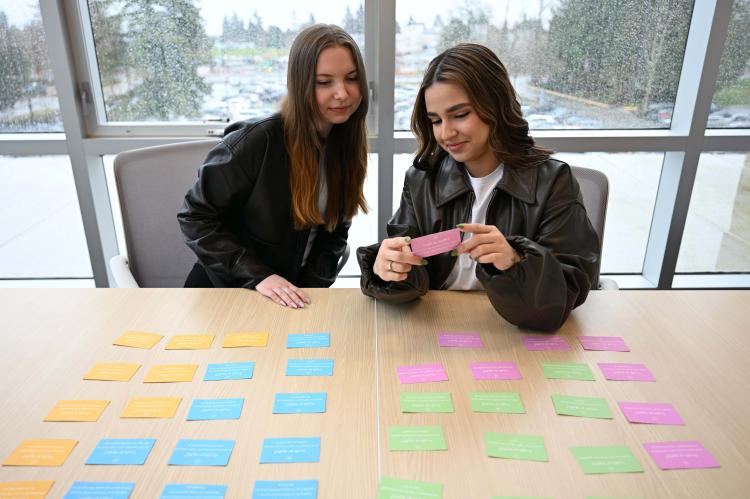
Natania Huckabay (left) and Emmily Martins with their card game, Truth or Myth?
Tasked with developing a community education project for their psychology course in human sexuality, Natania Huckabay and Emmily Martins came up with a unique game to assist children with body changes and boundaries.
The game, "Truth or Myth?" challenges children to consider statements printed on cards before deciding whether they are fact or fiction. Cards are colour-coded by category, covering topics from mental and physical health to gender and media, and the backside of each card contains a factual statement to educate players.
"We both work with children and saw gaps in the sexual education literature for that age group. That's why we wanted to create a tool for them," says Huckabay, who is in her final semester of the Bachelor of Arts, Major in Psychology program at KPU.
Outside the classroom, Huckabay works as a behavioural interventionist in the community, where she's now integrated the game into a sexual health program supporting neurodivergent children.
"The game was very well-received, and it's one of the tools we will use in the program. It has been helping children understand their sexual, emotional and mental health, and encouraging boundary formation and adherence," says Huckabay.
Martins recently graduated from KPU and now works as a literacy interventionist. She says children can learn by doing -- and the interactive aspect of the game helps engage participants.
"I find that children who need that hands-on-learning experience benefit the most. Finding a way to share important health information in a fun, non-intimidating way is especially beneficial in this day and age," says Martins.
For both students, the project demonstrated the need in the community for such resources.
"It taught me there are a lot of misconceptions out there," says Huckabay. "One of the categories we created in the game is media myths and misconceptions. It revealed gaps in the research that we're still seeking to fill and seeing how we can best engage students with that."
The game came from an assignment in Dr. Cory Pedersen's PSYC 3010 course, in which students critically examine research and theoretical perspectives that define the study of human sexuality. Students were tasked with creating a useful educational tool, rooted in empirical research, on any aspect of human sexuality related to the course.
"My hope is students will learn many things, including that dissemination of knowledge about human sexuality should be rooted in science, not morals or ethics. Although these are important for individuals, they impede effective education about such topics," says Pedersen.
Learning how to do effective research and how to share that knowledge in a fun and creative way are other dividends of the project.
"The fact that my students have produced such a wide range of projects for such a wide range of populations outside the class some which have actually been put into use suggests that they are exceptionally creative and in-tune with the sexual education needs of these various stakeholders," says Pedersen.
KPU offers students the choice between a Bachelor of Arts or a Bachelor of Science degree in psychology, along with an additional option of a Bachelor of Arts in Human Behaviour and Applied Psychology a program tailored for students interested in careers outside of care.