


Before this summer, Isabelle Pakoo had never conducted research.
The 25-year-old Oji-Cree from Shoal Lake, Saskatchewan, had just completed her nursing prerequisites through Mahkwa Omushki Kiim: Pathway to Indigenous Nursing Education (PINE) program in fall 2025 when she received an email about a summer research internship opportunity and decided to apply.
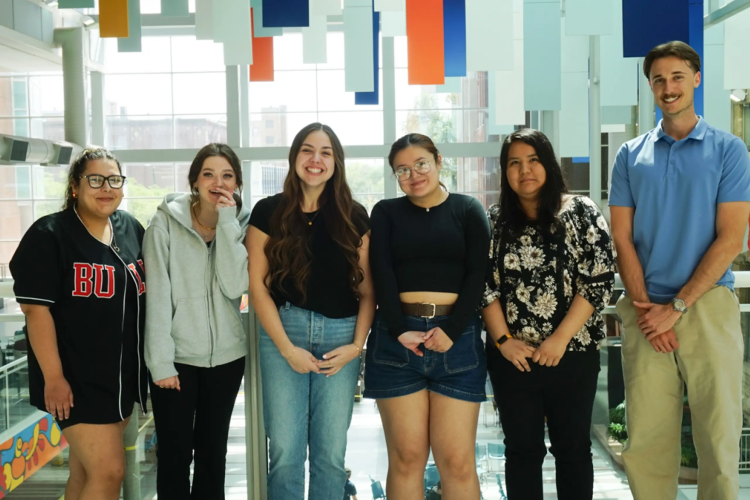
The PIKE-Net students on the UM Bannatyne campus, from left, Isabelle Pakoo, Payton Badiuk, Taylar Hanson-Oliveira, Shayla Fosseneuve, Kacy Cancade and Morgan Eby.
She was one of six undergraduate students from the University of Manitoba who participated in the 2026 Undergraduate Summer Research Internship hosted by the Prairie Indigenous Knowledge Exchange Network (PIKE-Net). Through the program, Indigenous students are introduced to health research while addressing issues that affect their communities.
The program inspired Pakoo to continue pursuing research. She was recently hired as a research assistant with the Genomics Equity through Indigenous Engagement and Nursing Education (GEIENE): Addressing Structural Inequities in Precision Cancer Care project at Athabasca University, in partnership with PINE. She began the position in September and will continue the role part-time as she starts her first year in the College of Nursing this winter.
Creating pathways into research
PIKE-Net, a mentorship program managed by the Network Environments for Indigenous Health Research (NEIHR) and housed within the Rady Faculty of Health Sciences' Ongomizwiin - Indigenous Institute of Health and Healing, is a partnership among the University of Manitoba, University of Winnipeg, University College of the North and Brandon University.
The 13-week program runs from May to August, and students receive a $7,000 stipend.
Hera Casidsid, Manitoba NEIHR program coordinator, said the summer internship is one of PIKE-Net's initiatives dedicated to connecting Indigenous students in Manitoba with First Nations, Inuit and Métis communities, and researchers working in Indigenous health.
"We want to help build health research capacity and develop the next generation of Indigenous health researchers, particularly in Manitoba," she said. "We want to improve their competitiveness, as well as develop sustainable collaboration among communities, researchers and students. Then they can all work together to do research that is important to the community."
Throughout the internship, PIKE-Net offered workshops and students participated in ceremonies and received teachings from Knowledge Keeper George Muswaggon, Dr. Amanda Fowler-Woods, a Medicine Carrier and a Manitoba NEIHR principal investigator, and Elder Geraldine Shingoose.
Dr. Linda Diffey, director of Ongomiizwin - Research and assistant professor in the College of Community and Global Health, said presentation skills are an important part of research. On the final day of the program, students presented their projects at a colloquium on Aug. 25.
"What I'll really be looking forward to is five or 10 years down the line to see where this program took you because a number of our past students came back and told us the summer they spent with us was a game changer," Diffey told students.
"Some of them ended up doing master's degrees ... You never know where the relationships you made this summer might lead."
Contributing to maternal and child health
Pakoo's research focused on strengthening breastfeeding knowledge and support for Inuit families.
"My lived experiences as a mother deeply shaped my interest in maternal health and the importance of culturally grounded care," she said, noting that many Inuit women travel from Nunavut and other northern communities to Winnipeg to give birth because specialized maternity services are not available in every community.
"Access to culturally safe care and breastfeeding support is essential for healthy mothers, strong families and thriving communities," she said.
Pakoo created a pamphlet that included a resource map and listed centres that could support mothers travelling to Winnipeg to give birth.
"This project is about uplifting Inuit voices and recognizing breastfeeding as both cultural and relational," she said.
"This will hopefully provide comfort for mothers by letting them know there are resources available that could help them with their pregnancy. These insights can also help health organizations and nurses provide more culturally safe breastfeeding support for Inuit families."
From intern to researcher
Mackenzie Chartrand is a third-year master's student in community health sciences in the College of Community and Global Health.
Chartrand was part of a panel of former PIKE-Net summer research students at the colloquium who went on to pursue research after their undergraduate studies.
She studies endometriosis among First Nations people who menstruate in Winnipeg. Endometriosis is a chronic inflammatory disease that occurs when tissue similar to the lining of the uterus grows outside the uterus. Chartrand said no research currently exists on endometriosis among First Nations populations.
The mother of a two-and-a-half-year-old balances motherhood with graduate studies and part-time work.
It was during the summer of 2020 that Chartrand joined the PIKE-Net program while completing her bachelor of health studies degree in the Rady Faculty's Interdisciplinary Health Program.
Looking back, she credits the experience with helping shape her career path.
"That was very pivotal in my decision to pursue a research career."
Click here to learn more about PIKE-Net.