


Three American commandos parachuted into Hungary, an Axis power, in March 1944 with an unusual objective: getting captured.
The mission, known as Operation Sparrow, sent Col. Florimond Duke, Capt. Guy Nunn, and Maj. Alfred Suarez behind enemy lines to help get Hungary to switch sides, and as part of a broader Allied effort to convince Adolf Hitler that the coming invasion of Europe would strike far from Normandy.
This operation remained largely overlooked for decades, overshadowed by other wartime deception efforts and buried by Cold War politics and top-secret classification.
Dr. Jason Bell, a philosophy professor at UNB, brought the story together in Operation Sparrow: The Incredible True Story of the Spies Who Tricked Hitler and Won the War. The book draws on archives in North America and Europe, newly declassified documents, memoirs, and years of research.
"It was really a hugely influential mission to the war," Bell said. "For reasons of Cold War politics, it never got properly appreciated."
Bell first encountered the story while researching his previous book, Cracking the Nazi Code. While tracing wartime intelligence records connected to Winthrop Bell, a New Brunswick-educated intelligence operative at the centre of that earlier book, he came across references to Operation Sparrow and was struck by its audacity.
"I just saw that there had not been a book written about it," Bell said. "My thought was, well, this has to be a book!"
A philosopher writing history
Bell is not a historian by training. He teaches philosophy.
Rather than writing a conventional academic history, Bell chose narrative non-fiction, a style that combines rigorous research with scenes and characters that read much like a novel.
He said the approach grew from advice he received while working on his first book, and from a desire to reach beyond a narrow academic audience.
"I'm somebody who trained in a method of philosophy that seeks engagement with the public sphere," he said.
Chasing the evidence
Reconstructing the story required work across several countries.
Bell consulted records at the U.S. National Archives in Maryland, Britain's National Archives, Hungarian-language sources, memoirs written by participants, and recently declassified intelligence material. He also travelled to sites connected to the operation to better understand the terrain and circumstances the commandos faced.
The three Americans at the centre of the story came from very different backgrounds.
Duke, then 48, was a First World War veteran who had played professional football for the New York Giants and built a career in advertising before joining the Office of Strategic Services, the wartime agency that later helped inspire the CIA.
Nunn served as a multilingual propaganda specialist, while Suarez was a radio and explosives expert.
Bell argues the operation was part of a wider deception campaign that preceded D-Day, reinforcing Hitler's belief that an Allied attack would come through southeastern Europe rather than northern France.
A declassified CIA study identified military benefits that earlier accounts had missed. Bell said his own research led him further.
"The 'failure' aspect of it was actually part of the plan," he said. "It was meant to look like it failed."
Students helped shape the book
Bell said UNB students played a significant role in bringing the project to publication.
One of them, Marie Petersen (BA'25), reviewed the manuscript from beginning to end, proofreading chapters, checking footnotes and citations, and identifying parts of the narrative that could be strengthened.
"I actually had Marie read the whole manuscript from start to finish, and she did another editorial pass," Bell said. "I implemented every suggestion she made."
For Petersen, the assignment offered a rare look at how historical research becomes a book.
"It was awesome," she said. "This was my first time working on a project intended for publication, so I wanted to do a good job providing thorough and helpful feedback."
A student with backgrounds in philosophy, English, and psychology, Petersen said she was particularly interested in Bell's decision to tell the story as narrative non-fiction.
"It helped me appreciate how Dr. Bell used various literary techniques to retell the historical events in an accessible and creative light that brought the people and the stories behind these documents to life," she said.
She had never heard of Operation Sparrow before encountering the manuscript.
"I loved having the opportunity to do an in-depth reading of a story like this one so early on," Petersen said.
The experience also gave her a new appreciation for the work involved in producing a book grounded in archival research.
"It was clear to me that a lot of time and research was undertaken to put together a project like this," she said.
Another contributor brought a very different perspective.
Joel Green is a retired member of the Canadian Armed Forces, former signaller, and a third-year UNB Fredericton student majoring in Criminology and Law in Society. He helped Bell interpret technical documents describing a highly advanced radio system the Sparrow team carried.
Bell had obtained newly declassified records relating to the equipment and wanted help understanding what he was looking at.
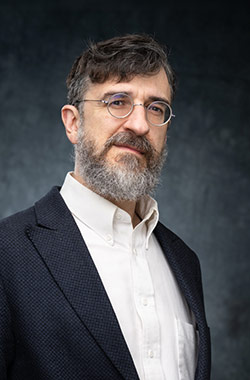
Dr. Jason Bell, a philosophy professor at UNB, author of Operation Sparrow: The Incredible True Story of the Spies Who Tricked Hitler and Won the War. (Photo: Cameron Fitch/UNB Media Services.)
"Joel instantly understood what was going on," Bell said. "It would have taken me, who knows, years of staring at it."
Green said the technology surprised him because it was sophisticated for its time.
"What stood out to me is the genius of the system," he said.
Although modern military communications equipment is far more advanced, Green said many of the same principles remain relevant.
"These are all still basic principles that are used today," he said.
Working on the project also changed how he viewed communications during the Second World War.
"I hadn't really thought about this type of capability," Green said. "When I would think about Second World War communications, I would think more of message encryption systems, and a manual Morse transmission."
He said the collaboration demonstrated the value of bringing together people with different backgrounds and areas of expertise.
"To me, it teaches the value of a university education in connecting people from different backgrounds to share knowledge," Green said. "Something one person might see as common sense, in the most common of worlds, might be a valuable observation in another's."
Archives and expertise close to home
Some of the book's most valuable source materials were found closer to home.
Bell credited the Harriet Irving Library's archival collections with helping him reconstruct events involving David Walker, a Scottish officer who later settled in New Brunswick. Walker's papers provided details that Bell said previous accounts had not told correctly.
"You need archivists who can find and catalogue these things," Bell said.
He also drew on expertise from the Gregg Centre for the Study of War and Society at UNB. Conversations with military historians Lee Windsor, Cindy Brown, and Mark Milner helped him understand the military and logistical realities behind the deception campaign.
Bell said the project reflects the value of the wider research environment around him, from archivists who preserved key records to students who contributed specialized knowledge.
For him, that may be one of the book's most important lessons.
"I want students to see the process," Bell said. "What is required to figure out what's true and what's false, and also how to communicate that to the public."
Operation Sparrow, The Incredible True Story of the Spies Who Tricked Hitler and Won the War, was released on Sept. 29 by HarperCollins. It has been named an Indigo Pick of the Month.