


Giving birth is often one of the most meaningful and joyous moments of a woman's life. A cherished and blessed time, especially when supported by their partner and surrounded by family and friends eager to welcome the newest addition to the family.
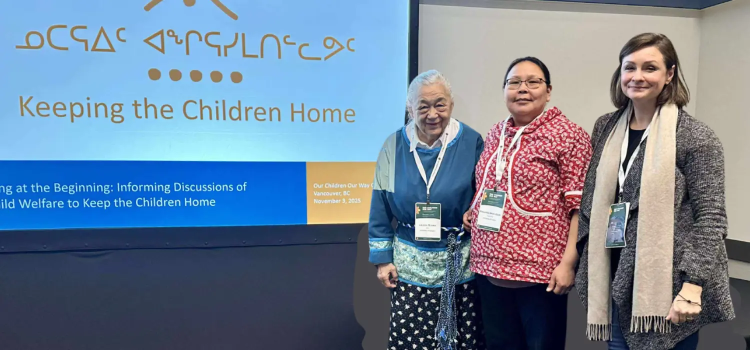
From left: Elder Levinia Brown, Inuk researcher Rosanna Amarudjuak and Patti Johnston at the Our Children Our Way Conference, Vancouver, 2025. Photo Credit: Robyn Long
For many Inuit women, particularly those from the Kivalliq Region in Nunavut, the situation is usually much, much different.
For instance, many Inuit women do not receive any prenatal care, and when they're ready to give birth they have to take a one or more flights from Inuit Nunangat (Inuit homelands, the Arctic) to a southerly cities. Often they have to do this alone, perhaps accompanied by young children - some very young - forced to leave behind their partners, family, culture and community, when they need them most.
To make matters worse, Inuit women (for whom English is often a second language) face considerable risks when travelling to urban environments. This can include the risk of losing their children, including newborn infants, to provincial child protective services, whose checklists can't begin to capture what the reality is for most people in Nunavut.
What should be a joyous time, is often a time filled with fear and overwhelming stress.
"Most people want the same things," says Dr. Patti Johnston, PhD, a researcher with the University of Calgary's Faculty of Social Work. "They want to be treated with respect. They want dignity in birthing. They want to be able to communicate with somebody and have their needs heard and responded to. It's like the lowest-hanging fruit that we haven't been able to pick for so many people in Canada."
Community-led research with a single goal
For more than two decades, Johnston has worked alongside Inuit women, families, youth and Elders in some of the most remote communities in Canada. Her pathway to research came through front-line experience as a social worker in Inuit communities where she gained first-hand insight and understanding of the structural issues, realities, barriers and challenges facing Inuit women and families, especially related to pregnancy, childbirth and interactions with child protective services.
Johnston found that health resources and prenatal supports where scarce, non-existent or available only in English. She also discovered that women have to travel thousands of kilometres to give birth or to find medical care for their children and families. Her early experiences would define her research career.
As Johnston's work shifted from front-line practice to research, she remained focused on what the community wanted and what their priorities were. For example, while Inuit women had been calling for better perinatal supports for years, they also shared something equally important. Despite gaps in formal services, Inuit women had always supported one another through pregnancy and birth.
"Inuit women, have always been resources for each other," says Johnston.
That insight became a foundational piece of the ongoing research. The community-based and highly-participatory approach to research she took emphasizes women's strengths while recognizing and formalizing existing peer networks, community knowledge and collective care as central to improving socio-health outcomes.
Before long, what began as a single project focused on exploring perinatal supports for Inuit women in Arviat, Nunavut, has grown into a network of interconnected initiatives spanning maternal health, youth leadership, policy, and practice change and community development.
The collaborative work now includes developing and testing culturally and linguistically accessible prenatal information; building networks of care and engagement with health and social-service providers; examining legislative and structural changes needed to support community-based birthing; and strengthening Inuit women's sexual and reproductive-health rights.
Each of these projects is animated by a single powerful idea: Keeping the children home.
It's a recurrent theme that was often repeated to Johnston from the Inuit Elders working with the team. Organically, and as a result, those she has known for many years, and others who are drawn to being a part of the effort, have joined in this research to build the collective now known as Keeping the Children Home (KtCH), named by Inuk Elder Tagaaq Evaluardjuk-Palmer.
"She's been really clear from the beginning," says Johnston. "She said, It's all keeping the children home. All of it.' She said, It doesn't matter if you're talking about youth training down at the University of Calgary. It's about how do we ensure that these youth come home ... It's about strengthening communities and making sure that the youth can stay with their families in their own communities and live in their culture and language.'"
Repatriating birth to Inuit communities
The Elder's wisdom of focusing on keeping the children home is, of course, central to better health and better outcomes for Inuit women and their extended families, as well as the communities they're from. Instead of leaving home by themselves, weeks before delivery, to navigate huge cities, hospitals and systems where they don't always speak English, mothers should receive culturally appropriate perinatal socio-health care and support, in their own language, from supportive community members.
They would have their families around them so that their child's birth can be celebrated and cherished, the way it should be.
KtCH has shaped Johnston's research and resulted in the work of advocating for, and exploring how to change policies and practices to keep families together, ensuring they have what they need to thrive, and remain connected to their communities, customs and homeland.
This includes developing sustainable perinatal educational resources and approaches grounded in Inuit ways of knowing and being and advocating for the the self-determination of Inuit women and communities.
Starting local and national conversations
To move toward this goal, Johnston is co-leading two major events this spring that look to connect and bring awareness to the web of issues that need to be fixed to keep the children home.
The biggest event will be a national gathering in Winnipeg April 30 and May 1, The Inuit Maternal-Child Health and Cultural Safety Conference, held in partnership with Dr. Zoua Vang, PhD; Nunavut Tunngavik Incorporated; and collaborators from across Canada. The national gathering will be focused on practice and research to increase culturally safe maternal-child health-care services across Inuit Nunangat (the traditional Inuit homeland that includes Nunavut and parts of Quebec and North-West Territories). It will bring together community members and leaders from Inuit Nunangat, researchers, policy leaders, midwives and other health professionals, and those with lived experiences, to share their knowledge, research and priorities for change.
As Johnston says, the event will fill a major gap in Canada by creating a space for collaboration in an area that has historically lacked dedicated national forums.
The national conference will be preceded by a workshop for practitioners in Edmonton, designed for front-line social work, health-care and allied health providers. The conference looks to better inform those who engage with Inuit women and families within the city when they arrive to give birth and seek medical care.
Rather than being celebrated and supported for the strengths and capacities they hold, Johnston's research has uncovered that, in today's already stressed health-care system, Inuit women and their families often experience racism and discrimination within health-care environments.
"There often there isn't a full understanding of the conditions that pregnant mothers and families are dealing with in the North," Johnston explains. "When those realities aren't well understood, mothers making the trip to a southern hospital can end up being blamed for circumstances that are actually structural."
The national conference looks to address this by offering support to health-care providers and social workers by way of providing insights, ideas and understandings specific to the interactions that they may have experienced or can routinely occur. Inuit women will share their experiences with health and social services directly to create opportunities for reflection and learning to encourage the provision of culturally safe care.
A career shaped by relationships
Johnston reflects that her work is founded on the deep relationships she's built over the years in her practice, research and collaboration.
What began as front-line social work has grown into a national mission shared and guided by Inuit women, Elders, youth and community partners.
As the momentum continues to build, the guiding vision remains unchanged: Keep the children home.
"Inuit women should have the option to give birth in their homes, in their communities, surrounded by supportive family and friends, and within their own culture while speaking their own language," Johnston says. "This is a critical part of starting healthy and strong families and a key goal of my research. It's why I'm passionate about this work."
The University of Calgary Faculty of Social Work is committed to advancing reconciliation by supporting Indigenous ways of knowing, being and doing alongside Western approaches. Grounded in a belief that community must be at the centre of everything we do, the faculty works in partnership with Indigenous communities to support community-led research that reflects local knowledge, priorities and strengths. Learn more in its annual reports and in its 2022-2027 strategic plan, A Place to Gather.