

When wildfire threatens a community, the decisions drivers make on the road can have a major impact on how quickly people reach safety.
For Natural Resources and Environmental Studies (NRES) PhD candidate Alireza Noory, understanding those decisions is driving research that could help improve wildfire evacuation planning in northern British Columbia and beyond.
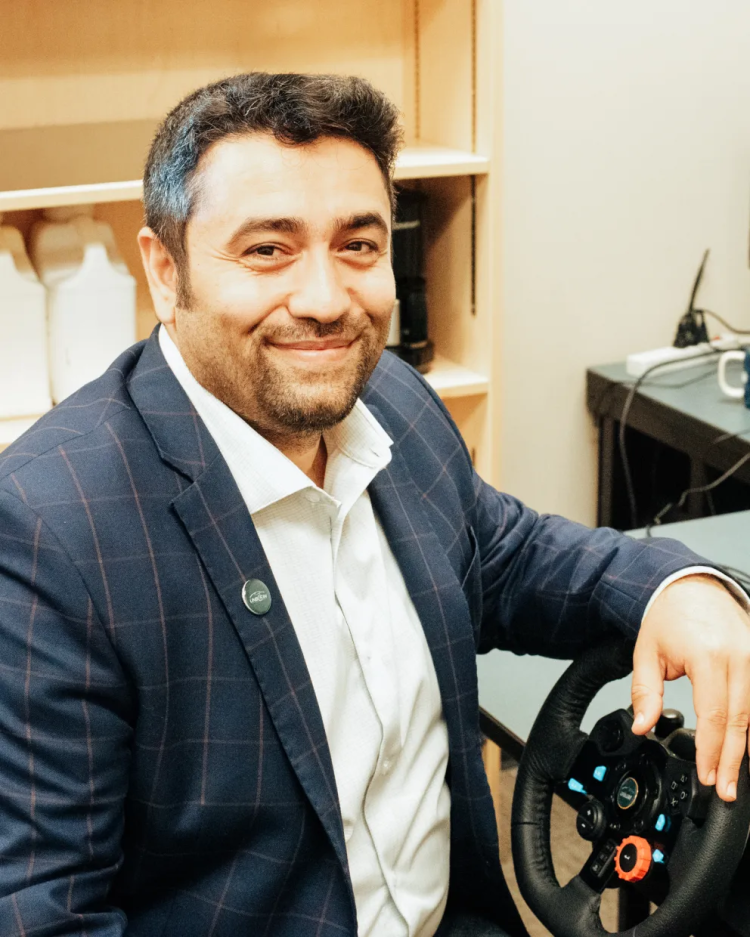
"Using behaviour collected from local drivers can make evacuation forecasts more realistic and help local agencies plan safer and more effective evacuation strategies," says Alireza. "This is important because many current evacuation models rely on general assumptions or data from other communities."
Working under the supervision of UNBC School of Engineering Professor Mauricio Dziedzic and Adjunct Professor Dr. Mohab El-Hakim, the PhD candidate has developed UNBCSIM, a driving simulator that recreates a section of Highway 97 North through Prince George. The simulator allows participants to experience the same stretch of road under two different conditions: a typical day and a wildfire evacuation scenario.
"The simulator will measure how drivers react during both scenarios: how quickly they respond at stops, how their speed changes and how they accelerate and brake," Alireza explains. "The data collected will be used to calibrate a separate computerized traffic model of Prince George that could help city officials and emergency planners examine how traffic may move during an evacuation and assess different strategies in advance of an emergency situation."
The research project has now entered its participant recruitment phase.
Alireza is seeking eligible adult drivers from Prince George and the surrounding region to volunteer to drive the simulator. He's looking for participants from across a range of ages and driving experience to spend about an hour on the simulator in a research lab at UNBC's Prince George campus.
"By observing volunteer participants in the controlled normal and wildfire scenarios, we can measure actual changes in driving behaviour," Alireza says. "The results will show how local drivers adjust their behaviour when visibility, urgency, emergency messages and wildfire-related hazards are introduced."
In addition to data collected from the volunteer participants, the research team will evaluate how well UNBCSIM reflects real driving by comparing simulator speed data with floating-car measurements - the average speed of a car moving with the flow of traffic - collected on the study section of the Highway 97 North being replicated in the simulator. The combined results will determine whether the simulator provides reliable information for calibrating the traffic evacuation model.
"This study will help strengthen evacuation planning in northern British Columbia by providing region-specific evidence about how drivers respond during wildfire emergencies," says the UNBC researcher. "The calibrated traffic model can be used to examine evacuation travel time, congestion, road closures and alternative traffic management strategies before an evacuation occurs."
More broadly, the approach creates a repeatable framework that other wildfire-prone and northern communities in Canada could adapt.
"Planning for wildfire evacuation is so much more than a transportation issue," says Alireza. "It involves natural hazards, emergency management, human behaviour, municipal planning and public safety."
With a background in transportation and civil engineering in Iran, Alireza chose UNBC's NRES program because of its interdisciplinary approach to tackling complex environmental challenges. After moving to Prince George with his family to live and work, his experiences helped shape his interest in research that can improve community safety.
Alireza developed UNBCSIM as a practical research tool for northern communities. However, the potential applications extend far beyond this current study.
The UNBC researcher applied for and received a Canadian copyright certificate, helping to protect the intellectual property.
"The certificate recognizes the simulator as an original Canadian research and software product;" says Alireza. "And helps strengthen its position for future academic research, public-sector applications, partnerships and potential commercialization opportunities."
For Alireza, this project is about building partnerships that will strengthen community preparedness while advancing research with practical, real-world impact.
"I'm looking forward to connecting with residents living in and around Prince George who are willing to contribute to this effort and to collaborating with local organizations and agencies interested in wildfire evacuation, transportation modelling and emergency preparedness."
To learn more and participate in the study, please contact Alireza Noory directly.
For more information

3333 University Way
Prince George British Columbia
Canada V2N 4Z9
www.unbc.ca