


Getting real work experience before graduation is tough. Most internships pay little, and many class projects never leave the classroom. This summer, a new program from DMZ tried to fix both problems at once - and paid students to do it.
The Embark Business Academy (Em-BA) is a 14-week career accelerator for Toronto Metropolitan University students and recent grads. It combines training in business skills, AI tools and career readiness with something rarer: real consulting work for real companies, backed by a paycheck.
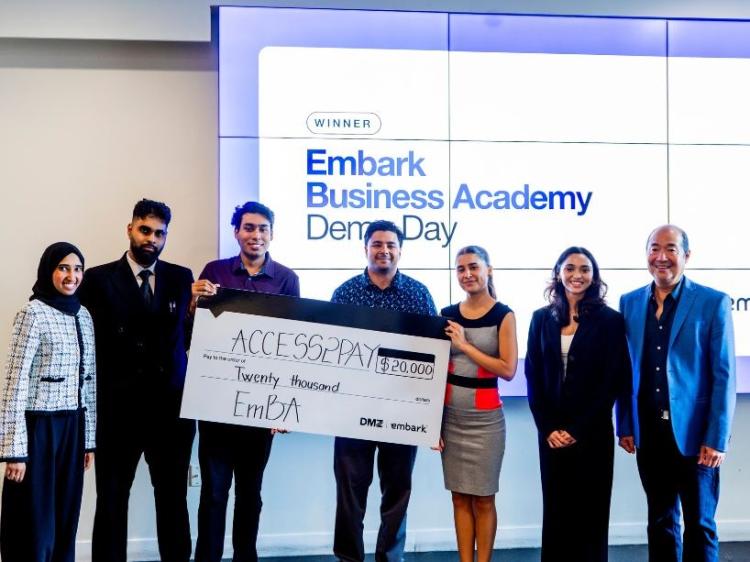
Team Access2Pay members and DMZ staff celebrate after taking the $20,000 top prize at the Embark Business Academy's first Demo Day, where five student teams pitched growth strategies to the Toronto companies they spent the summer advising.
From nearly 350 applicants to 5 winning teams
The program drew almost 350 applicants. After 14 weeks of workshops, DMZ selected 25 participants to move on to the capstone stage. Organized into five teams of five, they were matched with Canadian companies and given actual business problems to solve things like building go-to-market plans, improving customer acquisition, and figuring out how to expand into new markets.
Each participant earned a $3,000 stipend, so students didn't have to choose between paid work and gaining experience.
A $20,000 win for Team Access2Pay
Marie Klinaeva, a recent TMU grad starting her master's in computer science this September, led Team Access2Pay. Her group worked with Access2Pay, a Toronto fintech company that itself came up through DMZ' startup incubator, to find new markets for its revenue operations platform.
The team didn't just research from their laptops. They interviewed stakeholders, studied six potential sectors - including universities, hospitals, property management, transit, gaming and utilities - and built go-to-market recommendations the company could actually use.
That work paid off. Team Access2Pay won the $20,000 top prize at Em-BA's first Demo Day.
"The quality of thinking has made this a genuinely useful strategic input for our growth planning, not just a class exercise," said Anand Misir, CEO of Access2Pay. "We'd welcome the chance to host another cohort."
Real clients, real stakes
What set Em-BA apart from a typical school project was accountability. These weren't hypothetical case studies - companies could act on the recommendations, and students knew it.
Besides Access2Pay, teams tackled projects for four other organizations:
- Embark - improving RESP onboarding for Canadian families
- Arki - building a repeatable outbound sales process for this architecture software company
- SCOOTY - improving the rider experience on this transit platform
- Food Mamba - developing a Vancouver expansion strategy
Along the way, participants researched unfamiliar industries, collaborated with teammates, communicated directly with company leaders, and used AI tools to support their work. Instead of practicing a pitch for a grade, they presented final recommendations to a live audience and a panel of industry judges.
More than a resume line
By the end of the program, participants left with more than a bullet point for their resumes. They had real projects to talk about in interviews, professional connections, and hands-on proof they could apply classroom learning to actual business problems.
The program was free for participants thanks to a $500,000 grant from Embark Foundation, which also funded the paid stipends.
For students like Klinaeva, Em-BA is proof that learning doesn't have to stop at the classroom door - and that real-world experience can start before graduation, not after.