




The Rocky Mountains provide a picturesque backdrop for some of the most important environmental education and research in Canada.
From local junior high and high school students to undergraduate and graduate students, the University of Calgary's Barrier Lake Research Station has inspired many to follow their passions over the last 60 years.
One of only two UCalgary field-research stations in the Rockies, it and the Richard Birnie (R.B.) Miller Station, a research-only facility in Sheep River Provincial Park, are overseen by the UCalgary Biogeoscience Institute, recently renamed the University of Calgary Kananaskis Centre.
Over the years, it has become the home base for national and international researchers and collaborations, and has hosted visitors from around the world.
A rich Rocky Mountain history
Situated in the Kananaskis Valley along Highway 40, just six miles south of the Trans-Canada, construction began on the six-acre facility in early 1966, even as UCalgary itself prepared to relaunch as an independent university.
The original vision included two teaching laboratories and four research areas for students and staff, along with a lodge to provide sleeping dining quarters.
Mostly completed by that summer, its first cohort of researchers and students were quickly able to get into nature and start studying a largely unstudied area.
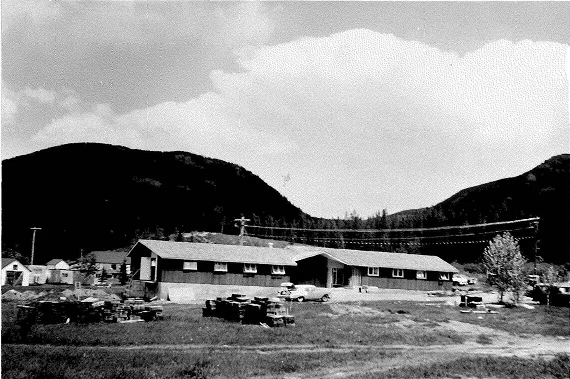
The laboratory block at UCalgary Kananaskis Centre in 1966. Photo Credit: UCalgary Kananaskis Centre
According to the centre's first director, Dr. James Cragg, PhD, it was an "extraordinarily successful" first session.
"There is a growing demand for knowledge of the natural environment," he said in an Aug. 27, 1966, interview with the Calgary Herald. "This summer was essentially a tryout. All students thoroughly enjoyed it."
Cragg said there was a great need to study nature in its undisturbed state in an age of increasing pollution, adding the area provided a very diverse mix of bogs, lakes, streams, hills, mountains and habitats for a variety of wildlife.
The Richard Birnie (R.B.) Miller Station, a research-only facility located in Sheep River Provincial Park, and UCalgary's other Rockies field-research station, also dates back to the late 1960s.
A wide array of research
"We've become known as a place to come and work, with easy access to glaciers, mountains, forests, lakes, rivers and small mammals," says Dr. Steven Vamosi, PhD, current scientific director for the UCalgary Kananaskis Centre. "It's not just a place to study the environment, as we are also being mindful of the human presence."
As Vamosi and his staff map out the future for Barrier Lake, they hope to build on the last 60 years of success through community and connection with nature.
Over the ensuing years, Vamosi says the variety and depth of research being undertaken at Barrier Lake is something the UCalgary community should be proud of.
He points to the work around bighorn sheep as a prime example, which includes tracking population dynamics and even horn size over time in response to hunting.
Vamosi says excellent research has also been going on at Marmot Creek Basin on how water systems work and how we can better understand glaciers, as well as work on butterflies and how they are impacted by forest fires and climate change.
"From the very beginning, we have had some really forward-thinking researchers here who have wanted to study montane ecosystems using a variety of approaches, as well as the relationship between humans and our environment," he says. "They have always really wanted to go out there. They have been passionate about it, to go get funding for it and make it self-sustaining."
More than just scholarly activities
While research is the primary focus at Barrier Lake, the facility also functions as an educational base for school groups, UCalgary undergraduate students and visitors.
Barrier Lake field research manager Adrienne Cunnings, BSc'10, MSc'13, says they have seen groups from ecology and environmental science to engineering and arts.
For many, it's an eye-opening experience to see the world in a different way with the serene surroundings.
"Being outside allows for more inquiry-based learning to happen," Cunnings says. "It allows for students to take what they learn in a classroom and spend a day outside to do actual field work."
While it's important to have various groups out to work and play in the mountains, Cunnings says the Barrier Lake team is also mindful of the need for balance so the station isn't overrun by people, potentially scaring off wildlife or having a negative impact on ecosystems.
A future worth preserving
As Vamosi and Cunnings look ahead to the next 60 years, they say community and connection will be key to Barrier Lake's continued success.
Vamosi says they have taken pride in working with local Indigenous communities to enhance the depth of learning and research happening at the facility. The team is working with Elders to document names and stories associated with the area to honour ancestors.
As an example, Vamosi says some of the most important trails in the region, including what is now a paved Highway 40, have a history that long predates the arrival of settlers, and it's important for field station visitors to see and appreciate the history.
He hopes this knowledge also inspires visitors to turn off their devices and truly get into nature.
"As Calgary continues to grow and urbanize, I think these sites will only become more valuable and more impactful," Vamosi says. "Let's get out of the classroom, out of the city, go outside, and get some real sun, real rain, real sleet - sometimes all in the same day - and you may encounter some real wildlife."
Cunnings says they are also eternally grateful to have the backing from the UCalgary community, as more faculty, staff, students, alumni and donors view Barrier Lake as an essential part of the extended campus.
"The key to our success has been the support from the university, especially from President Ed McCauley," she says. "He has been so incredibly supportive of the field station and it's truly the reason why we're still here."
Read more about the Barrier Lake Field Station and its offerings.


