




An international group of astronomers, including from York University's department of Physics and Astronomy, using the world's most powerful space telescope, have made a surprising discovery about a galaxy long, long ago and far, far away: It isn't rotating.
That's something typically seen in more mature galaxies that are closer to us in space and time, says Ben Forrest, a research scientist at the Department of Physics and Astronomy at the University of California, Davis, and first author on the paper published May 4 in Nature Astronomy.
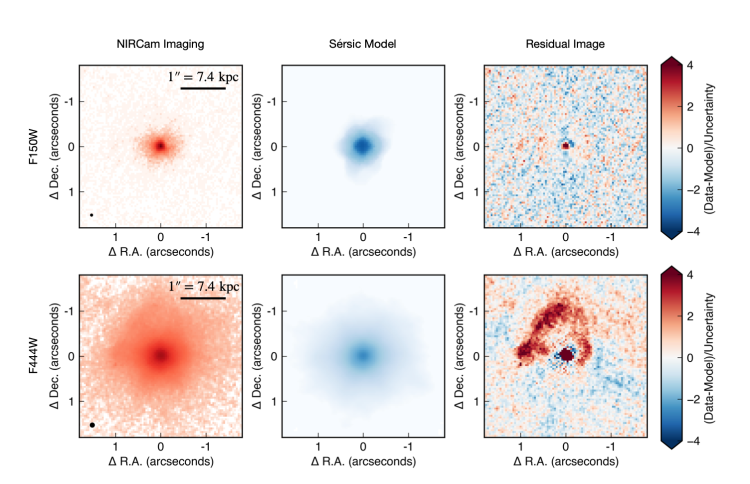
Modeling of XMM-VID1-2075
"This one in particular did not show any evidence of rotation, which was surprising and very interesting," Forrest said.
According to current theories, as the first galaxies formed, irregularities in gas flows and the influence of gravity set them spinning.
Over many billions of years, some galaxies, especially those within galaxy clusters, merged with each other multiple times and their combined rotations added to or partly canceled each other. That's why some galaxies that are closest to Earth (and therefore also relatively recent) can show little overall rotation but a lot of random movement of stars within them.

Prof. Adam Muzzin
This process should take an enormously long time, so it's surprising that galaxy XMM-VID1-2075 had achieved this state when the universe was less than two billion years old.
Forrest and colleagues, including second author and York University Physics and Astronomy Professor Adam Muzzin, who worked closely on the research with Forrest, had previously observed this galaxy with another observatory in Hawaii.
"We were especially keen to do this observation as it is one the most massive galaxies from the early universe," says Muzzin. "Detecting these types of galaxies is challenging and the observations can be subtle, but that keeps the work interesting."
The team used the James Webb Space Telescope (JWST) to take a closer look at XMM-VID1-2075 and two other objects of similar age. With instruments on the Webb telescope, they were able to measure the relative movement of material inside them.
Of the three galaxies they sampled, one is clearly rotating, one is "kind of messy," and one has no rotation but a lot of random motion. "That's consistent with some of the most massive galaxies in the local universe, but it was a bit surprising to find it so early on," says Forrest.
How did this galaxy become a "slow rotator" in less than two billion years? One possibility is that it is the result not of multiple mergers, but a single collision between two galaxies rotating pretty much in opposite directions. That idea is supported by the team's observations.
"For this particular galaxy, we see a large excess of light off to the side. And so that's suggestive of some other object which has come in and is interacting with the system and potentially changing its dynamics," Forrest said.
The astronomers are continuing to look for other, similar objects in the early universe. By comparing their observations with simulations, they can test theories about galaxy formation.
Last year, Muzzin was granted the largest ever allotment for a single researcher on the JWST and says that this research is not just about understanding this particular galaxy, but gives us clues as to the origin story of the universe, and through that humanity.
"This is literally where it all started, where we all came from," says Muzzin. "This research is one important step in understanding that story more fully."
The work was supported by grants from NASA, the Space Telescope Science Institute and National Science Foundation.


