




The saying life is a balancing act is truer for some than others and few groups are more painfully aware of that than many people in our senior communities.
Among elderly populations, fall-related injuries are a common hazard. A 2022 report from the Public Health Agency of Canada found that falls are the leading cause of injury-related hospitalizations and injury deaths among people aged 65 and older.
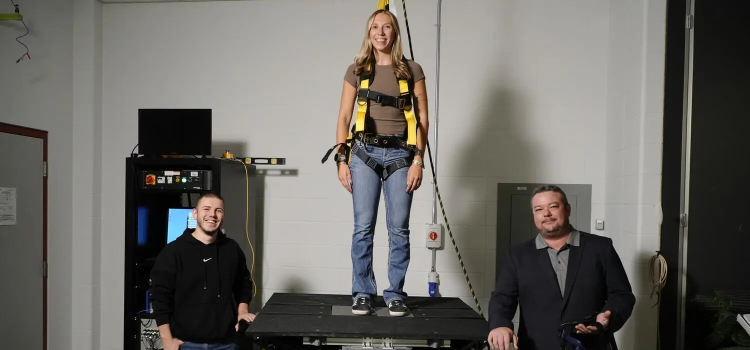
Ryan Peters (right) demonstrates the Hexapod platform with volunteers Chanel Cabak (centre) and Baris Baysal. Photo Courtesy of Kyle Sieben
One major reason for this is the human balance system begins to decline as early as the age of 40 due to age-related changes in the vestibular balance organs of the inner ear. This is according to a study by Johns Hopkins University School of Medicine. By the age of 80, 85 per cent of individuals demonstrate age-related balance impairments.
Dr. Ryan Peters, PhD, an associate professor in the Faculty of Kinesiology, has developed a potential new treatment for people struggling with balance impairments. Right now, he is looking at older adults, but studies are also underway aimed at those suffering from conditions like vertigo, strokes, multiple sclerosis or the aftermath of head injuries.
At the centre of Peters' work is The Hexapod. Currently housed in the University of Calgary's Human Performance Lab, it's a heavy-duty robotic platform used to study balance impairments.
"Imagine standing on a bus or a train that suddenly starts moving and you need to catch your balance," says Peters, a member of the Hotchkiss Brain Institute at the Cumming School of Medicine. "We've all experienced that in some way. This is called dynamic balance control' and we'll be using this platform to study how balance is controlled in healthy individuals across their lifespan, as well as the changes that occur with aging, concussions, strokes and other factors which compromise our balance system."
Study participants, suited in a safety harness to catch their potential fall, stand on the Hexapod platform which shifts beneath their feet. "The platform allows for these Cadillac-type experiments where we can upset the surface you're standing on," says Peters. "How do you recover if we do that? It requires a very fast, sophisticated reaction, a whole-body sort of reflex that activates muscle and movement patterns in correction of that sudden perturbation. This robotic platform reads those movements back to the computer, giving us a far more comprehensive and functional picture of your balance system."
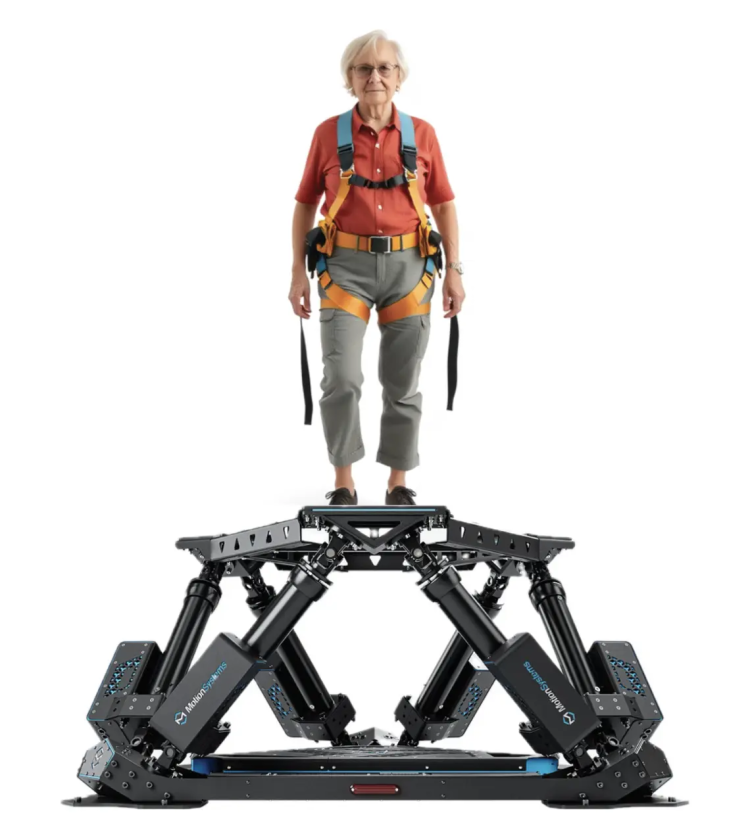
The Hexapod platform is currently being used as a potential treatment for older adults with balance impairments. Photo Courtesy of Ryan Peters.
The Hexapod is being used in conjunction with Neurvesta. This second piece of technology is another innovation developed in a partnership between Peters' Integrative Sensorimotor Neuroscience Laboratory and the company Neursantys, with offices in Calgary, Silicon Valley and Chicago. Peters is the company's chief science officer.
Neurvesta is a wearable device which places electrodes behind each ear, sending electrical stimulation to the declining vestibular organs. "We've demonstrated that applying this stimulation for six weeks, with three 20-minute sessions per week, leads to neuroplastic restoration within the vestibular organs and significant improvements in balance and mobility," says Peters. "This, in turn, reduces the risk of falling."
Used in conjunction with the Hexapod, Peters envisions a "balance training protocol" where the robotic platform will serve to measure and optimize the effects of the neurostimulation therapy. "The platform can be employed as a tool to benchmark and assess balance before, during, and after the Neurvesta treatments," Peters says. "We also believe it may serve as a treatment itself."
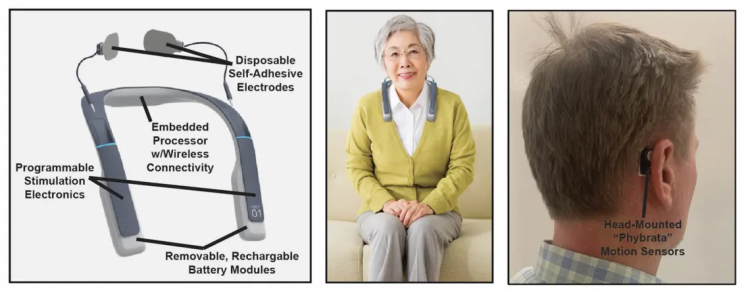
Neurvesta is a wearable device being used to restore declining inner ear organs in older adults, reducing the risk of falls. Photo Courtesy of Neursantys
He adds: "Taking it to the next level, we also plan to incorporate immersive VR (virtual reality) into our balance regimen." This may include a realistic simulation in which patients take an elevator ride to the top of a virtual 80-story skyscraper. The elevator door opens to a single plank leading out over the side of the building.
"Can you imagine a sudden jolt when you're standing on that plank, which appears to be 80-stories high? Some people develop such fear after they've had their first fall that it isolates them socially where they're afraid to leave the house. Putting people in these extreme virtual situations could be a form of exposure therapy. If they can face this virtual scenario, it may help them regain their confidence in everyday situations."
Though Peters has been focused on age-related balance decline, astronauts struggling with balance impairments after prolonged exposure to microgravity are another group that could also benefit from this research. "We've developed our Neurvesta stimulators alongside the Canadian Space Agency to see if it might alleviate the symptoms of motion sickness astronauts contend with," he says.
"Down the road we'd love to have astronauts in the lab trying our Hexapod platform."
The Hexapod platform was obtained thanks to a Canada Foundation for Innovation John R. Edwards Leaders Fund award received by Dr. Ryan Peters and Dr. Tyler Cluff.


