


Kwantlen Polytechnic University (KPU) is receiving a $358,507 federal grant to expand a field school that provides training for First Nations archeologists and Land Guardians.
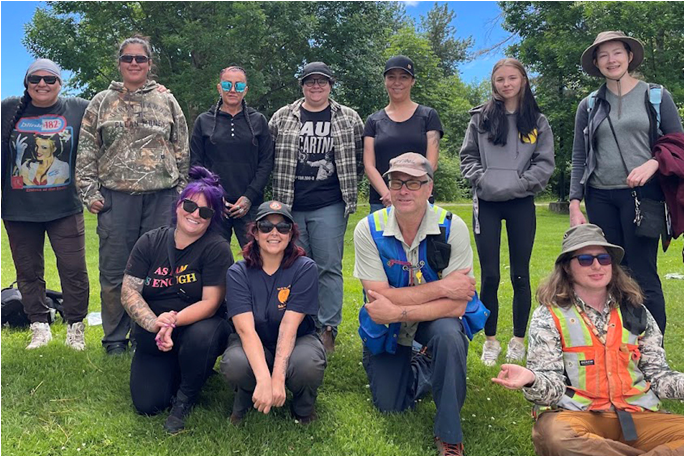
KPU anthropology instructor Brian Pegg (front row, third from left) is leading a field school for First Nations archeologists and Land Guardians.
The field school aims to address a growing need for more First Nations professionals in archeology, strengthening Indigenous capacity to lead and inform work involving their own heritage.
As demand for archeological expertise continues to grow across B.C., the program also creates pathways into a field that offers strong career opportunities.
"One of the things that First Nations need in order to have a greater role in directing archeology work and making recommendations themselves is a greater capacity to do archeology at a professional level," says Brian Pegg, a KPU anthropology instructor and field school lead. "There are not enough trained archeologists to meet the demand for projects happening across B.C."
The three-year Natural Sciences and Engineering Research Council of Canada (NSERC) grant will support the field school's continuation after its successful launch this past spring.
Pegg says one of the stipulations of the United Nations Declaration on the Rights of Indigenous Peoples is that Indigenous people can control their own heritage and history.
"That's quite reasonable and they should be able to do so. To be able to control their own history, they need to be able to undertake archeology projects. A lot of them have substantial experience doing archeology, but just less substantial formalized training, which can help them get into supervisory positions doing archeology."
Archeological evidence provides a physical record of thousands of years of Indigenous history in B.C. Pegg says increasing the number of trained First Nations archeologists helps communities take a greater role in researching, interpreting and protecting that history.
"With the First Nations, with Indigenous groups, it's their own history. Prior to the colonial period, these communities were not using writing to document their history. They documented it through oral histories, as well as the material remains left in the ground."
The six-credit, tuition-free field school is designed for First Nations students with field experience or an interest in land-based archeology, and develops skills in GPS data collection, landscape history and cultural materials identification. Classroom instruction is combined with online learning and community-based projects selected and supervised by KPU's partner nations.
KPU's Indigenous Admissions Committee helped create pathways for some students to enter the field school program by recognizing that academic potential and lived experience are not always reflected in traditional admission requirements.
"There were students who maybe didn't have some of the high school requirements. We were able to assess their existing knowledge and their suitability for studying at KPU, not just for the field school, but studying at KPU as a whole," says Dr. Larissa Petrillo, special advisor for strategic initiatives at KPU. "This is a new initiative and it has a core social justice component whereby KPU wants to right the wrongs of just looking at one way of gaining access to a university."