


Research teams from Polytechnique Montréal and the University of British Columbia (UBC) have taken an important step towards a new generation of semiconductor-based quantum processors. For the first time, the group has designed a germanium-based device that is almost entirely free of atomic "noise," a long-standing barrier that had, until now, slowed the development of this approach. Their work was recently published in Advanced Science.
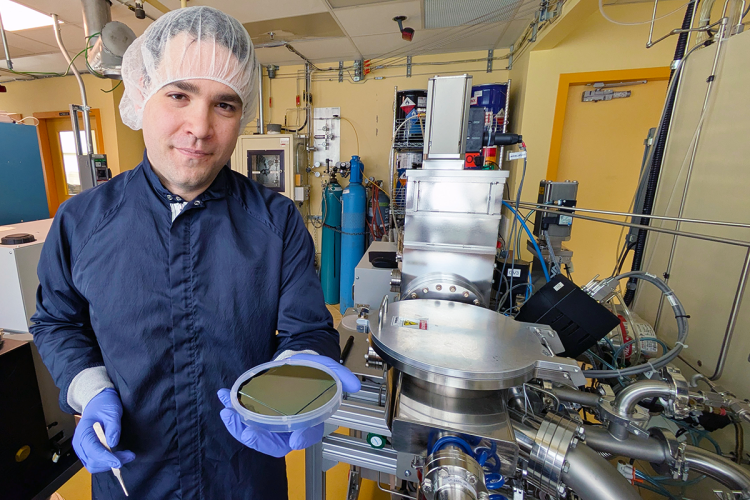
Patrick Daoust, postdoctoral fellow and first author of the study, fabricating quantum structures on silicon wafers using epitaxial growth -- a technique that allows the formation of a crystalline layer only a few dozen atoms thick. (Credit: Martin Primeau)
Research teams from Polytechnique Montréal and the University of British Columbia (UBC) have taken an important step towards a new generation of semiconductor-based quantum processors. For the first time, the group has designed a germanium-based device that is almost entirely free of atomic "noise," a long-standing barrier that had, until now, slowed the development of this approach. Their work was recently published in Advanced Science.
As the first quantum computers begin to emerge around us, research teams worldwide are working to define the technologies of tomorrow and, ultimately, the standard way of fabricating a qubit -- the basic unit of quantum information.
Some groups are developing superconducting platforms, the approach behind the early systems produced by IBM and Google. Others are pursuing trapped ions, quantum defects in diamond, or semiconductor-based strategies. The team led by Oussama Moutanabbir, professor in the Department of Engineering Physics at Polytechnique Montréal, has committed to this fourth pathway -- and his explanations make it easy to understand why.
"To design the chips used in today's computers, we already rely on existing semiconductor manufacturing infrastructure," explains Professor Moutanabbir, who also serves as Scientific Director of Polytechnique Montréal's Lassonde Deeptech Institute. "Building quantum chips using similar processes opens the door to rapid scaling, enabling us to move from devices with only a few qubits to versions containing thousands, and eventually millions."
The Promise of Germanium for Quantum Technologies
Before we can build quantum computers with many qubits, we first need devices that are reliable and capable of preserving the information stored in them over long periods. To achieve this, the Polytechnique team is turning to a material closely related to silicon in the periodic table: germanium.
In its crystalline form, germanium acts as a semiconductor: it not only conducts electricity, but more importantly allows researchers to control the flow of electrons through tiny electrical variations. And this is only one of the essential criteria for fabricating semiconductor-based qubits, explains Patrick Daoust, postdoctoral researcher and first author of the study.
"The material must above all allow us to store quantum information for long durations," Daoust notes. He adds that compatibility with silicon and with standard semiconductor fabrication processes is another key requirement -- and germanium crystals check all the boxes.
However, what appeared promising on paper did not immediately translate into working devices. Early germanium crystals tested for their quantum properties suffered from a critical issue: some of the silicon and germanium atoms they contained generated magnetic interference that disrupted the device's behaviour.
The culprits are known as silicon-29 (29Si) and germanium-73 (73Ge). These alternative forms of silicon and germanium -- called isotopes -- have quantum properties that differ from those of silicon-28 and germanium-70, the versions researchers actually seek. "At the quantum level, it's a real problem," explains Professor Moutanabbir. "29Si and 73Ge behave like tiny magnetic dipoles that make quantum signals too unstable to be meaningfully exploited."
To address this at the source, the team established a platform at Polytechnique Montréal dedicated to producing isotopically pure crystals that remain fully compatible with today's industrial standards. With 29Si and 73Ge removed, the new crystals contain only the isotopes relevant to quantum research.
A West Coast Boost
This initiative made it possible to produce a new generation of germanium and silicon crystals, but the team still needed to confirm that they delivered on their theoretical promise. To verify this, the Montréal researchers partnered with Professor Joe Salfi's group at UBC's Stewart Blusson Quantum Matter Institute to evaluate the magneto-electric properties of the germanium crystals.
By applying electrical voltages, the UBC team demonstrated that it was possible to steer the electronic behaviour of the structure. In other words, they could manipulate how electric charges distribute themselves inside the crystal -- an essential prerequisite for envisioning the creation of a qubit inside germanium.
Although this milestone represents major progress, the road toward semiconductor-based quantum computers remains long. But by eliminating one of the main sources of atomic "noise" in germanium crystals, the teams at Polytechnique Montréal and UBC have removed a significant bottleneck and brought this technology closer to industrial reality.
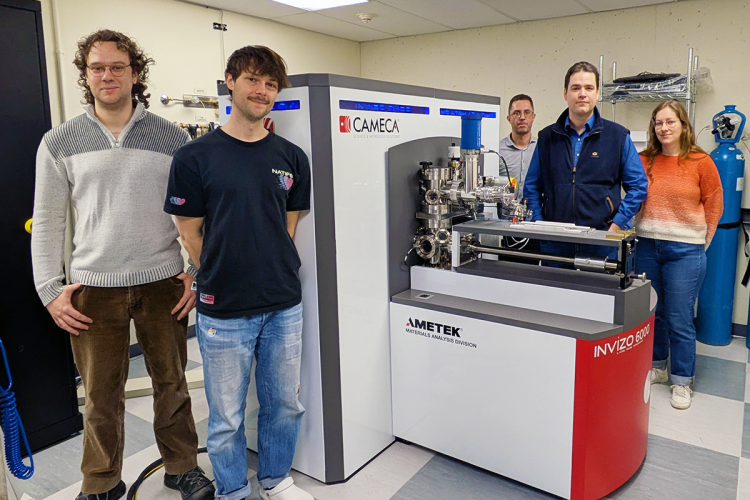
From left to right: Alexis Dubé-Valade, Nicolas Rotaru, Sebastian Koelling, Patrick Daoust and Eloïse Rahier, all members of Oussama Moutanabbir's team, contributed to this scientific publication, supported by the PolyAPT atom probe tomography platform at Polytechnique Montréal -- a tool that makes it possible to analyze the atomic structure of samples one atom at a time (credit: Martin Primeau).
This work was made possible through primary support from Canada's Department of National Defence Innovation for Defence Excellence and Security (IDEaS) program, as well as several additional funding partners, including NSERC, the Canada Foundation for Innovation (CFI), Mitacs and PRIMA Québec.
Learn More
- Scientific article in Advanced Science
- Expert profile Professor Oussama Moutanabbir
- Department of Engineering Physics website
- PolyAPT Platform website
- Expert profile Professor Joseph Salfi
- Stewart Blusson Quantum Matter Institute (UBC) website
For more information

2500, Chemin de Polytechnique, Bureau A-201, 2e étage
Montréal Québec
Canada H3C 3A7
www.polymtl.ca