


Nine faculty members from McMaster University will be inducted into the Canadian Academy of Health Sciences (CAHS) as fellows.
The induction is among the highest recognitions of excellence in Canadian academic health sciences. CAHS is a distinguished and esteemed institution dedicated to advancing health research, knowledge and policy in Canada.
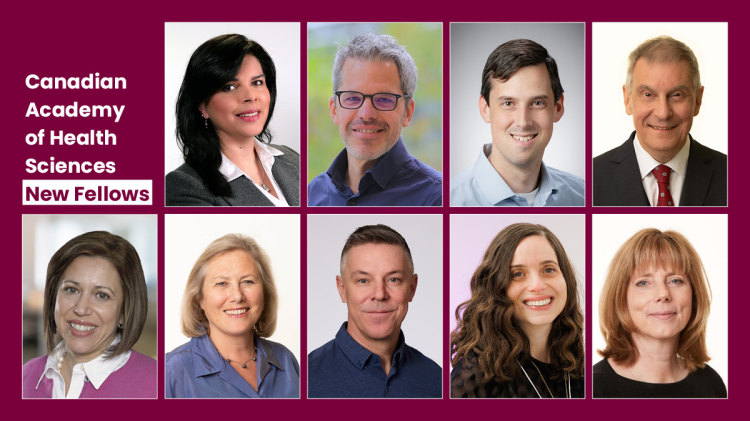
Nine McMaster faculty members have been named fellows of the Canadian Academy of Health Sciences, one of the highest honours for individuals in the health sciences community.
The fellows are:
Gina Agarwal, professor in the Department of Family Medicine
A Tier 1 Canada Research Chair in Vulnerable Individuals in Primary Care, Agarwal is the founder of the Vulnerable Individuals in Primary Care Research Lab at McMaster University and the award-winning Community Paramedicine at Clinic (CP@Clinic) program, which brings preventive care directly into social housing communities.
An internationally recognized family physician and expert in global health promotion and disease prevention programs, community paramedicine and population health, Agarwal has produced over 200 peer-reviewed publications with more than 123,000 citations and an h-index of 59. She provides strategic leadership in integrating community paramedicine with primary care and housing services, advancing innovative models of care that improve the health and quality of life of older adults and other vulnerable populations worldwide.
"It is a privilege to be inducted as a Fellow of the Canadian Academy of Health Sciences. Caring for vulnerable populations as a family physician on multiple continents has inspired and shaped my health research career. Guided by a lifelong commitment to giving back, I am motivated to contribute to the Academy's mission and work with fellow members to advance equitable health and improve the lives of vulnerable populations."
Brian Coombes, professor in the Department of Biochemistry & Biomedical Sciences
An internationally recognized microbiologist, Coombes has revealed mechanisms that enable bacterial pathogens to adapt to the host environment and evade immune defenses, with his laboratory playing a key role in linking a type of E. coli to Crohn's disease.
Since 2017, Coombes has served as chair of McMaster's Department of Biochemistry and Biomedical Sciences. He is a Fellow of the American Academy of Microbiology, former Tier 2 Canada Research Chair in Infectious Disease Pathogenesis, and recipient of Canada's Top 40 Under 40, the Fisher Scientific Award for Career Achievement from the Canadian Society of Microbiologists, the Boehringer Ingelheim Investigator Award in Biological Sciences, and the Public Health Agency of Canada's Most Promising Researcher Merit Award.
"I'm deeply honoured to be elected as a Fellow of the Canadian Academy of Health Sciences. This recognition reflects the collective efforts of the students, trainees, staff, collaborators and colleagues I've had the privilege to work with throughout my career. Science is a team endeavor and this recognition highlights the strength of the research community we've built together at McMaster."
Todd Hoare, professor in the Department of Chemical Engineering
Hoare has helped develop injectable hydrogels that provide better lubrication that can help people living with osteoarthritis. In addition to hydrogels, Hoare is internationally recognized for designing soft nanoparticles for diverse applications, including drug delivery, tissue regeneration, wound healing, and viscosupplementation. He most recently was part of a team that created a new silicone-based material for medical use.
Hoare, the Tier 1 Canada Research Chair in Engineered Smart Materials, has been a leader with various professional societies that have promoted interdisciplinary collaboration and equitable recruitment, training, and results dissemination in biomaterials science and engineering.
"I am honoured to be included in this cohort of distinguished health scientists. Our lab is dedicated to designing new hydrogel and nanoparticle-based solutions to treat diverse health challenges including osteoarthritis, cancer, infected wounds, and fibrotic diseases in collaboration with clinical researchers, and the clinical connections possible through CAHS will accelerate our ability to commercialize these technologies through start-ups or partnerships with other Canadian companies."
Paul Moayyedi, professor in the Department of Medicine
A world-renowned gastroenterologist, Moayyedi has authored over 515 peer-reviewed publications and has been cited more than 94,000 times. His work on fecal microbiota transplantation has helped expand treatments for inflammatory bowel disease (IBD). He is the principal investigator of the IMAGINE SPOR Network, a nationwide project exploring how diet and the microbiome influence IBD and irritable bowel syndrome. The initiative is backed by $35 million in funding from the Canadian Institutes of Health Research.
Moayyedi has served as co-editor-in-chief of Gastroenterology, the field's highest-impact journal, and co-led the American Journal of Gastroenterology. He holds the role as joint coordinating editor of the Cochrane Gastrointestinal Review Group, where he has advanced evidence-based clinical standards internationally.
"I am honoured to be elected as a Fellow of the Canadian Academy of Health Sciences. One of the Academy's missions is to independently assess science and technology issues and support timely advice on urgent health issues. My research focuses on evidence based medicine and I look forward to supporting the Academy in providing authoritative unbiased advice on health issues that help improve the health of all Canadians. I also have strong international connections and look forward collaborating with international academies."
Alexandra Papaioannou, professor in the Department of Medicine
Papaioannou is an internationally recognized leader in geriatric medicine, osteoporosis, frailty, and brain health. She is Professor of Medicine at McMaster University, Executive Director of the Geras Centre for Aging Research at Hamilton Health Sciences, Tier 1 Canada Research Chair in Geriatric Medicine and Healthy Aging, and Chair of the Regional Geriatric Program Central.
She has advanced evidence-based care through research, clinical practice, and health-system innovation. Her work has shaped national guidelines, improved care models across hospitals, community, and long-term care. She has published more than 465 peer-reviewed papers and secured more than $96 million in research funding.
"I am deeply honoured to receive this recognition and grateful to the colleagues, trainees and partners who have contributed to this work."
Julie Richardson, professor emeritus in the School of Rehabilitation Science
Richardson is a distinguished rehabilitation scientist whose pioneering research has transformed understanding of mobility, functional decline, chronic disease management, and healthy aging. She has advanced evidence-based rehabilitation through innovative research, interdisciplinary collaboration, and exceptional academic leadership. Her research and advocacy contributed to integrating physiotherapists into Ontario family health teams. She received the Centenary Award of Distinction from the Canadian Physiotherapy Association for leadership and innovation to the profession. She created training pathways to prepare clinician scientists for dual research and clinical careers in Rehabilitation Science.
Her work has improved the lives of older adults and individuals living with chronic illness while influencing rehabilitation practice, education, and health policy nationally and internationally.
"I am honored to receive a Fellowship from the Academy of Health Sciences which recognizes the work of many rehabilitation teams and trainees. I look forward to contributing to the work of the academy especially around the functional health of Canadians."
Jonathan Sherbino, professor in the Department of Medicine
The assistant dean of health professions education research and the William J. Walsh Chair in Medical Education, Sherbino is an important leader in the Faculty of Health Sciences through the McMaster Health Education Research, Innovation and Theory (MERIT) Centre.
A dedicated emergency physician and clinical educator, Sherbino holds an Academy of Medical Educators Fellowship (United Kingdom) and a 3M National Teaching Fellowship. He spearheaded Canada's first nationwide transition of a medical specialty to competency-based education, leading curriculum reform across 17 medical schools and coordinating the work of more than 40 national educators.
"Health sciences education offers a way forward, in part, to address the challenges facing our complex health system. I'm proud of the research and innovation my collaborators bring to improving our education programs - from co-designing the framework that guides health professions training in over 50 jurisdictions worldwide, to co-leading research that challenges assumptions about clinical reasoning and physician error. Whether it's the incremental impact of a national curriculum or the findings of a single study, this work advances education and, in turn, clinical care."
Leyla Soleymani, professor in the Department of Engineering Physics
Soleymani holds a leadership role as the university's associate vice-president research (commercialization and entrepreneurship), is a Tier 1 Canada Research Chair in Miniaturized Biomedical Devices and is a Dorothy Killam Fellow. Soleymani is internationally recognized for her work in biosensing and biointerfaces research.
She has developed innovative technologies, leveraging advanced materials, to enable rapid disease diagnosis and continuous health monitoring technologies for infectious disease, cancer, and metabolic disorders, and has advanced their commercialization to improve health care. Soleymani was recently named lead of engineering innovation at NexusHealth, a McMaster University-based innovation accelerator.
"I am thrilled to be inducted into the Canadian Academy of Health Sciences, which will provide the opportunity to become even more deeply engaged with Canada's health sciences community and to contribute to improving health outcomes in Canada and around the world."
Laurel Trainor, professor in the Department of Psychology, Neuroscience & Behaviour
Trainor created the world's first purpose-built research concert hall - the LIVELab located within the McMaster Institute for Music and the Mind - using biosensing and motion analyses to uncover how people interact musically. A pioneer in music neuroscience, she served as the LIVELab's founding scientific director.
As a Tier 1 Canada Research Chair and Fellow of the Royal Society of Canada, she applies her research in developing musical interventions for premature infants; music therapy to reduce stress and anxiety in university students; and improving hearing aids for live music to increase enjoyment and reduce social isolation in the elderly.
"The power of music to move us emotionally, help to optimally wire our brains, and enhance social bonds has deep evolutionary origins. I think we are only beginning to realize the potential of harnessing music for human health and wellbeing. I am honored to be inducted into the Canadian Academy of Health Science, and look forward to contributing to its mission of applying evidence-based research to solutions that improve the health and quality of life of Canadians."