


By 2030, researchers with the Alzheimer Society of Canada estimate that nearly one million Canadians could be living with some form of dementia. That would equal roughly 187,000 new cases on a yearly basis by that time. Calgary alone can expect 34,000 people to be diagnosed annually.
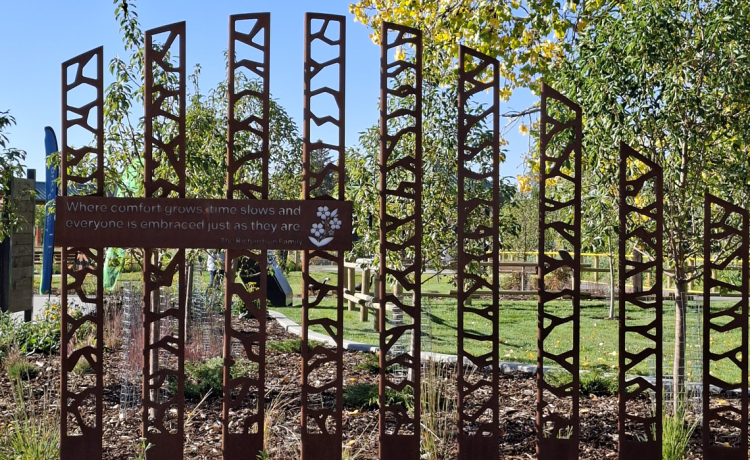
A decorative installation in the Martin Family Legacy Garden.
With no cure and an aging population, resources are needed, not just for those affected by the disease, but their caregivers too. There are several different types and causes of dementia. Alzheimer's disease and vascular dementia are among the most common, but many are affected by others, including Creutzfeldt-Jakob disease, dementia with Lewy bodies, frontotemporal dementia and mixed dementia.
With this in mind, a combined effort between community advocates, donors, researchers and other professionals has led to the development and building of a new park in south Calgary specifically designed to meet the needs of those living with dementia.
Inside Southview Park in the community of Dover, you'll now find the Martin Family Legacy Garden, the first ever dementia-inclusive park in Canada. The location was specifically chosen as it sits near the Greater Forest Lawn 55+ Society and the Bethany Riverview care facility.
A grand opening was held on Sept. 21., World Alzheimer Day. Hundreds of people attended including the people, organizations and researchers involved.
Caring in nature
Elements of the park have been carefully designed based on the most current dementia research. It includes details such as sensory gardens, ample wayfinding signage, colourful, wide pathways, and lots of seating and shaded areas.
Included will be public art, birdhouses and plants and flowers specifically chosen for sensory experiences.
"It is fundamentally a place for natural caring," says Dr. Sonya Jakubec, PhD, RN. The professor with MRU's School of Nursing and Midwifery was one of many researchers who consulted on the project.
In addition to her work at MRU, Jakubec also contributes to U of C's Centre on Aging through the O'Brien Institute for Public Health. Her research and area of expertise focuses on connections between nature and well-being.
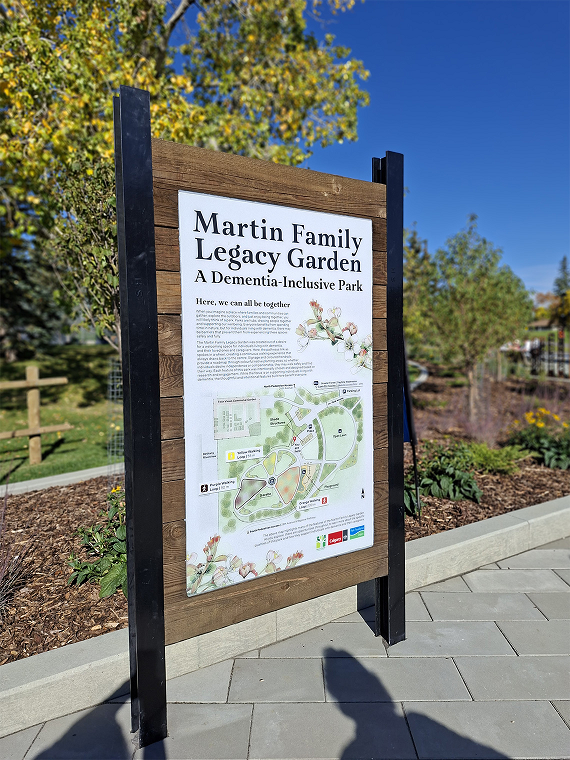
The park features sensory gardens, clear signage, wide pathways and abundant shaded seating.
Jakubec also examines the benefits of inclusive parks for people of all ages and abilities, including those struggling with grief or in palliative care, something she says allowed her to bring practical examples and current evidence to early conversations about the Martin Family Legacy Garden.
"We know that, for both people with any kind of dementia and their caregivers, time outside improves physical health as well as mood, anxiety, agitation, stress and sleep. We also know that time outside improves social relationships and a sense of belonging for people."
Jakubec adds that when people are in nature together, social relationships and dynamics change.
"On a walk or just being outside together, the dynamic of professional or family caregiver and patient' shifts to just being humans together, remembering that we are part of nature and that we are all in our different seasons of life."
She points to new guidelines from the World Health Organization (WHO), which outline ways that up to 45 per cent of dementia risks could be prevented. The WHO says things like tobacco and alcohol use, social isolation and physical inactivity are modifiable risk factors and recommends several healthy lifestyle and behaviour interventions to lower risk of developing the disease.
"So, connecting to parks and nature has an important connection to dementia in terms of support and prevention," Jakubec says, who also notes how needed this sort of resource is.
"There is a growing need for human connection, for acceptance, diversity and an invitation to nature connection. We have growing awareness of the kind of isolation and loneliness among people of all ages in our society, and particularly of the kinds of structural barriers to inclusion."
Building community
Jakubec says that much of the necessary care and support in our communities is not specifically clinical or medical, but at the level of family, neighbourhood, workplace and other supports.
That goes for both caregivers and patients, which is why she says the park is so vital.
"This park establishes, resources and normalizes places for community- and neighbourhood-level caring."
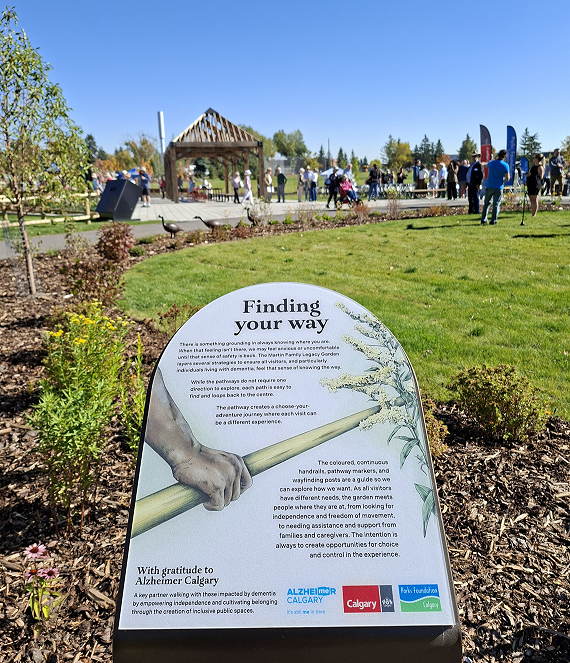
Swing benches, a central gazebo and an intergenerational playground offer spaces for connection.
Swing benches, a central gazebo and even an intergenerational playground will all allow for moments of connection. A partner swing at the playground will allow grandparents to swing with grandchildren and other family members. Signage will also explain the reason behind the park.
Jakubec commends everyone who came together to make it happen and also the way in which it came together.
"It was remarkable," she says, reflecting on early meetings during the pandemic. She says it was primarily those with dementia, their caregivers and loved ones, and professional caregivers, all gathered looking at designs.
Jakubec says their thoughts and opinions were carefully considered, leading to "the best example of community consultation that I have ever been a part of."
She was also able to provide her expertise on accessibility.
"Something emphasized in my research on the place of parks and nature in palliative and grief care and other long-term care parks/nature interventions, is that even when parks and accessible gardens and space are available; access is not always equal or easy."
Sometimes, she explains, getting outside is difficult, even to just sit on a bench for a stroll, roll or walk.
"We found that weather or environmental conditions were not the biggest barriers, sometimes caregivers' comfort or training, institutional policies, or just individual interests were barriers. Sometimes illness and appointments or lack of transportation or other resources got in the way."
So when it comes to parks access and inclusion, Jakubec says there are numerous factors that go into making parks and nature truly accessible, available, affordable and easy.
"In some ways this takes a mindset shift at numerous levels and at times it takes material and instrumental changes, education or resources. Why? Because even if getting outside seems difficult or challenging for people with disabilities, in palliative and grief care, and for people with dementias and their caregivers, it is always worth it!"