


For University of Windsor science alumna Kathryn Bernard (BSc '76), the genus of bacteria Bernardella has a special ring to it.
In 2026, a group of Canadian scientists named a new genus of bacteria Bernardella in recognition of her career as a bacteriologist.
The newly described species, Bernardella vulneris, was identified through the study of 11 bacterial strains, most of which were recovered from human wounds.
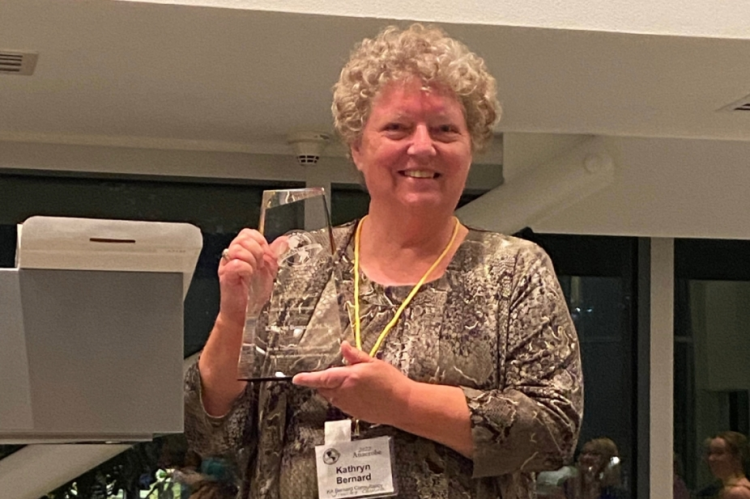
Kathryn Bernard received a Lifetime Achievement Award from the Anaerobe Society of the Americas in Seattle in 2022. (Courtesy of Kathryn Bernard/University of Windsor)
Bernard says she is the first Canadian woman to have both a bacterial genus and species named in her honour.
"I'm the only Canadian woman with a species named after me, and now the only Canadian woman with a genus and species named after me," Bernard says.
"I'm profoundly proud to be the only Canadian woman for this distinction, but it is also wrong and appalling that only a few women have been so honoured by the microbiology community. It's bittersweet."
This is the second time Bernard has had a bacterium named after her.
In 1995, a species now known as Trueperella bernardiae was named after her. The bacterium can cause abscesses and other infections in humans and, more rarely, disease in animals.
"I was in my 30s and that was remarkable," she says.
"It was quite a shock and a thrill. It got to the point where people across the country in different labs sometimes would send me a strain of it for identification just for the fun of it."
For 41 years, when a rare and unusual bacterial pathogen turned up in Canada and could not be identified, it often ended up in Bernard's lab.
Bernard and her colleagues studied unidentifiable bacteria which had caused disease in humans, characterizing the organisms and often formally describing those microbes that proved new to science at the federal government's National Microbiology Laboratory, located in Winnipeg after relocation from Ottawa in 1998.
"Some pathogens are very rare and many labs did not know how or have time to fully characterize them. A system had been set up in Canada that if an organism couldn't be identified to genus and species, it could be sent to our lab for further identification," she says.
"I had collaborations with a variety of labs across the country for this purpose."
Bernard says her team encountered organisms that could not be identified in existing scientific literature quite frequently.
The organism now known as Bernardella vulneris was among those mysteries.
"Strains of this particular organism, now called Bernardella, were recovered from wounds and essentially you have to give a name to the unidentifiable microbe before you start the process of writing a paper," Bernard says.
Researchers examined 11 previously unidentified strains collected over an eight-year period, ultimately determining they represented a new genus and species.
"Often in this day and age, a new genus and species would be named after a single strain, but having 11 strains that were unidentifiable but identical to each other, over an eight-year period, is quite an interesting piece to this."
The researchers, largely based at Bernard's former Winnipeg laboratory, chose to honour her contributions to microbiology by giving the new genus her name.
After years of naming bacteria, often in honour of worthy scientists, the tables were turned in 2026.
Bernard says naming a new organism can take the better part of a year, requiring extensive research to establish how it differs from previously identified species.
Throughout her career, Bernard made a point of honouring women whose contributions to science had too often gone unrecognized.
"My team and I have named probably at least half dozen new bacterial genera or species after women" she says.
"We started by looking at women who historically had not been properly recognized in their era, like Rosalind Franklin, a co-discoverer of the structure of DNA - our group named a genus after her."
Bernard says the imbalance in scientific naming remains striking. Research published in 2023 found that only a tiny proportion of bacterial genera named after people honoured women.
"It's an honour and it's in perpetuity and I'm quite proud of it," she says.
Beyond identifying and naming rare bacteria, Bernard contributed extensively to microbiological research, publishing scientific papers, writing textbook chapters and presenting her findings at major conferences, including those of the American Society for Microbiology.
Her expertise also placed her at the centre of a number of significant public health responses.
After relocation to Winnipeg in 1998, Bernard's laboratory became involved in work related to identifying highly dangerous bacterial pathogens because the Winnipeg facility had the specialized containment facilities required for studying them safely.
This was tested in October 2001, as her lab became the focus for national response to look for anthrax in powdered form, after that bacterium had been found to have been disseminated in that form by mail in the United States.
"My lab had the proper containment facility for identification, and from 1998-2005, my laboratory was in charge of studying such highly pathogenic organisms such as anthrax either naturally occurring or as possible bioterrorist events," she says.
"That was interesting work. We became very involved with the federal, provincial and municipal emergency response communities, should there be a threat of using these organisms as biological weapons."
Although Bernard retired five years ago, she remains semi active in the scientific community, such as by reviewing research papers for scientific journals or providing an occasional lecture at the University of Manitoba.