

Dr. Aaron Phillips, PhD, always knew he wanted to be a scientist.
He grew up a curious child with an appetite for learning, discovery and understanding how things worked. He was inspired in his youth by an uncle a scientist who would arrive at the family farm plot carrying a laptop and stories of discovery and by frequent visits to the library with his father.
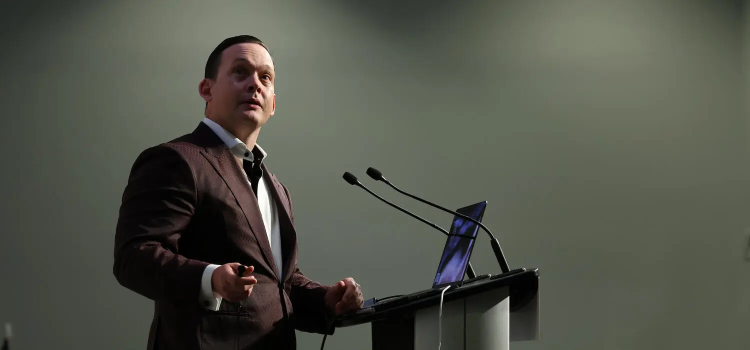
Photo Credit: Tim Fraser
A defining moment came in sixth grade when he was selected to attend an academic program for gifted students.
"Those programs gave you a lot of self-belief," Phillips says. "Believing in yourself and thinking highly of what you could contribute to society made me want to be a scientist and believe I could have an impact."
Today, Phillips' impact is being recognized on a national stage. Just 15 years into his scientific career, Phillips has emerged as a leader in spinal cord injury (SCI) research, having advanced monitoring and therapeutic innovations for neurological and hemodynamic conditions while helping to reshape care for people living with SCI.
A professor in the departments of Clinical Neurosciences, Physiology and Pharmacology, and Cardiac Sciences and the Associate Dean of Innovation and Commercialization at the Cumming School of Medicine (CSM), Phillips has been awarded the Gairdner Foundation's Peter Gilgan Canada Gairdner Momentum Award, a prestigious acknowledgement of his groundbreaking work.
The national recognition places Phillips among a distinguished group of researchers. He is only the second University of Calgary recipient of a Gairdner Award, along with the CSM's Dr. Samuel Weiss, PhD, who previously received a Gairdner International Award in 2008.
"This acknowledgement of Dr. Phillips' many accomplishments is an extraordinary milestone for one of the CSM's leading researchers," says CSM dean Dr. Todd Anderson, MD'85. "Canada Gairdner Awards celebrate some of the world's most influential biomedical and global health scientists, and Dr. Phillips has earned that recognition at a relatively early stage in his career."
From discovery to therapy
The Gairdner Foundation has recognized Phillips for reshaping the understanding and treatment of autonomic dysfunction after spinal cord injury and beyond. By demonstrating that targeted spinal stimulation can restore dysregulated blood pressure a significant and often overlooked SCI complication Phillips' work has opened a new therapeutic pathway with potential applications for a range of conditions.
Phillips has built an interdisciplinary research program spanning neuroscience, cardiovascular physiology, bioengineering and clinical translation. His work began with the discovery of hemodynamic hotspots within the thoracic spinal cord. Building on those discoveries, Phillips and his team conducted clinical studies involving people with chronic SCI and severe hypotension. As published in a rare double publication in both Nature and Nature Medicine, the studies revealed the therapy could restore stable blood pressure, reduce reliance on medication, and allow people to engage more fully in daily life.
His therapy uses an implantable neuromodulation device developed by Phillips with licensing and manufacturing partner ONWARD Medical that delivers targeted electrical stimulation to the spinal cord. The technology has received FDA Breakthrough Therapy Designation and is currently advancing through pivotal trials for market approval in neurosurgical research centres across Canada, Europe and the United States with results expected in 2027. A pivotal trial is a large-scale clinical study designed to provide the definitive scientific evidence of a new medical treatment's safety and effectiveness to secure market approval from regulatory agencies.
For Phillips, one of the most rewarding aspects of the work is seeing laboratory discoveries translate into real-world impact. The therapy has been used in 20 people around the world, with remarkable results.
"We're now in the middle of our pivotal trial, and if we meet our endpoints, this therapy could become available to the vast number people who need it. It's not just in the lab anymore. We have a true translational pipeline."
A desire to help people
Personal connections have had a strong influence on Phillips' research direction. Over the years he developed friendships with people living with SCI, including an engineer who worked in his lab. Phillips recalls visiting his colleague's apartment and being struck by the number of blood pressure monitoring devices needed to manage his condition.
Through those relationships he gained a better understanding of the challenges associated with blood pressure instability after SCI.
"I've been involved in spinal cord science for 15 years, and I've worked to integrate deeply within the community," he says. "I thought it was necessary to learn more about the people impacted and to understand the condition."
Guided by patient experience and need, Phillips' research has shifted away from the traditional focus on physical impacts of SCI. While much of SCI care has centred on restoring movement, many patients live with chronic hypotension, a condition that can cause debilitating fatigue, impaired cognitive function and an increased risk of cardiovascular disease over time.
"I started learning more and thinking this might be an open space where you could make a discovery and help people through science," Phillips says. "That's how I got into this, and from there the journey was pretty logical."
Along with leading the CSM's Innovation and Commercialization Office, Phillips has led a research lab for almost a decade and directs the Restore Network, a research platform he co-founded that bridges medical research institutes and biomedical engineering at UCalgary. He founded and leads a graduate-level course on commercializing medical neuro-technologies, and has multiple patents including mathematical modelling, neurostimulation hardware and brain computer interfaces.
Phillips has received a progression of awards including the Arthur C. Guyton Award for Excellence in Integrative Physiology and Medicine in 2021, UCalgary's Killam Emerging Research Leader Award in 2022, the 2023 Science and PINS Prize from the journal Science and the American Association for the Advancement of Science, and the 2023 Hopewell M.I.N.D. (Maximizing Innovation in Neuroscience Discovery) Prize, which helped to advance his research on neuro-recovery after spinal cord injury.
Celebrating a team achievement
The Peter Gilgan Canada Gairdner Momentum Award is presented annually to two mid-career investigators working in Canada whose research has made exceptional scientific contributions to human health and shows significant potential for future impact. However, Phillips doesn't perceive the award as a recognition of personal achievement. He says it acknowledges collaborative work that has been at times full of tribulation and risk.
"Science is a challenging and competitive career. Submitting papers, getting rejected, it all starts when you're young. So, when these moments come along and there's a win and a recognition of a body of work, it makes me want to celebrate them with my team."
Aaron Phillips is a professor in the departments of Clinical Neurosciences, Physiology & Pharmacology, and Cardiac Sciences and associate dean, Innovation & Commercialization, at the Cumming School of Medicine (CSM). He is a member of Hotchkiss Brain Institute and the Libin Cardiovascular Institute, and director of the CSM's Restore Network.