

This story is the third part of a series dedicated to the University of New Brunswick's important role in furthering Canada's defence capabilities. UNB is a national leader in defence-aligned research, helping protect Canadians and strengthen sovereignty through applied innovation, trusted partnerships, and made-in-Canada expertise. UNB advances cutting-edge research and develops the talent and technologies that support Canada's military, governments, critical infrastructure, and citizens.
Dr. P.T. Jayachandran's research on the upper atmosphere is helping improve communications and positioning in the Arctic for everything from search-and-rescue teams to the Canadian Armed Forces.
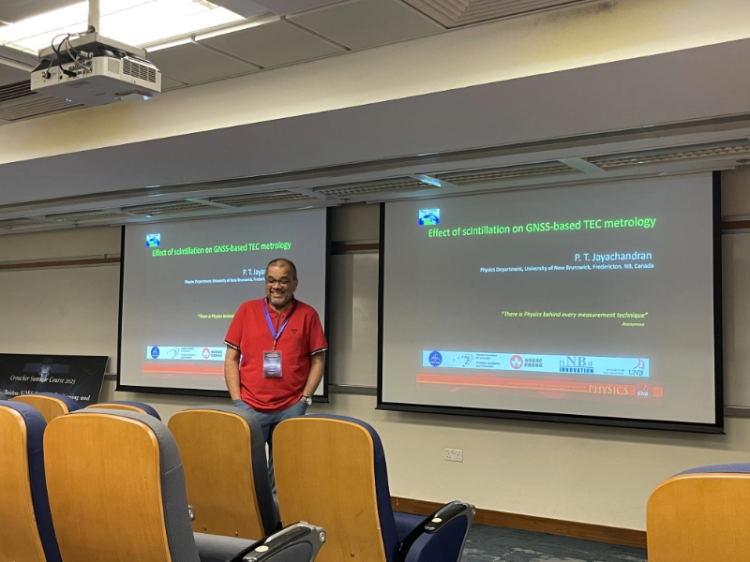
Dr. P.T. Jayachandran giving a seminar and lecture at the Croucher Summer School in Hong Kong.
The northern lights are among the Arctic's most familiar sights. As magnificent as they are, they indicate that conditions may be disrupting the signals that enable trouble-free communication and precision navigation.
For nearly 30 years, UNB physics professor Dr. P.T. Jayachandran has been studying these disturbances and their effects on radio-based systems.
His research, recently profiled in the Natural Sciences and Engineering Research Council of Canada (NSERC) publication Impact, focuses on the ionosphere, a region of the upper atmosphere about 90 kilometres and higher that can alter or disrupt signals used for GPS, communications, timing, radar, and other technologies.
It can affect how aircraft navigate, how emergency responders locate people in distress, how northern communities stay connected, and how Canada stays aware of activity in the Arctic. With Canada investing in increased satellite communications in the North for civilian and military purposes, Jayachandran's research becomes more important than ever.
A dual-use capability
Many of the systems affected by the ionosphere serve both civilian and defence users.
Commercial airlines, emergency responders, mining companies, northern communities, and the Canadian Armed Forces all rely on communications, navigation, and positioning systems whose signals pass through the upper atmosphere.
Jayachandran said his team has been involved in defence-related research for roughly 15 years and has contributed to work on positioning, navigation, and timing, as well as Canada's role in modernizing NORAD.
"We are working on improving the precision of satellite-based PNT (positioning, navigation, and timing) systems," he said. "It involves the defence of the North."
The same knowledge that improves civilian positioning and communications can also support operations, monitoring, and improve all-domain situational awareness in the North.
"These data 34 sensors are giving you real-time data, real-time information can be used for improving defence operations and national security," he said.
Jayachandran also sees a broader benefit.
"If I have good communication 24/7 anywhere in the Arctic, that's a good thing. People are connected to other parts of the country."
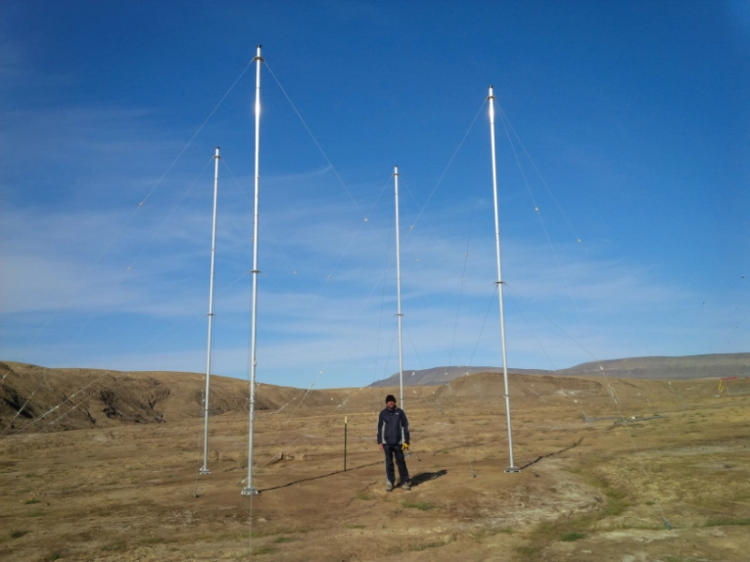
Dr. P.T. Jayachandran in the middle of the radar antenna at Eureka, Nunavut.
Understanding a changing environment
The Arctic experiences some of the strongest ionospheric disturbances in the world because of its proximity to Earth's magnetic pole. The same forces that create the aurora borealis (called the aurora australis at the South Pole) can also interfere with communication and PNT systems.
Charged particles from the sun, called the solar wind, hit gases in the ionosphere. The geometry and topology of the planet's magnetic field move these solar particles to the region surrounding the magnetic poles. When solar particles hit gas atoms/molecules, they energize them, and they release the energy as coloured light when they return to a "normal" state.
"We are always fascinated by the spectacular northern lights. It is good to look at for our own amusement. But they will pose problems for modern technological systems because they indicate variations or disturbances in that region," Jayachandran said.
These disturbances are not static. They shift in location and intensity, sometimes affecting areas far beyond the High Arctic.
Understanding when they occur and how they affect technology has become increasingly important as Canada places greater emphasis on northern operations, Arctic security, and sovereignty.
A network built over decades
Jayachandran and his team have built a research capability that spans the Canadian Arctic.
The physicist first travelled to the Arctic in 1998. At the time, observations were sparse, and large areas of the North remained difficult to study in detail.
What began with three monitoring stations has grown into the Canadian High Arctic Ionospheric Network, or CHAIN, which today includes 34 sites across northern Canada. The stations use specialized GPS receivers, radar systems, and other instruments to collect real-time data on conditions in the upper atmosphere.
"We started with three, and currently we have 34 stations in the Arctic, so that means it is giving us more information so that we can look at the details of this impact," he said.
"Our CHAIN is one of the largest networks in the world for this particular purpose."
The network provides researchers with a detailed picture of a region that remains difficult to access and operate in. It also provides information that can be used to better understand how atmospheric disturbances affect critical technologies.
Practical benefits on the ground
The research supports a wide range of civilian applications.
Precision positioning is increasingly important in sectors such as mining, surveying, transportation, and aviation. Atmospheric corrections derived from ionospheric observations can improve the accuracy of systems that depend on satellite navigation.
"If you are using a precision drill for various purposes such as mining, you want to have centimetre-level precision for that drill bit," Jayachandran said. "We use these atmospheric corrections so that they can improve the precision."
The work can also influence emergency responses.
Search-and-rescue operations depend on accurate positioning and reliable communications. During severe ionospheric disturbances, those systems can become less accurate or stop working altogether.
"Improvements in communications and the precision of PNT systems can save time, effort, and resources in harsh environmental conditions such as the Arctic, and knowledge of the ionospheric conditions plays a critical role in it," Jayachandran said.
"And sometimes, this system may not work at all and knowing when and where that happens will be useful for finding alternate solutions."
Researchers can often identify when major space weather events are likely to occur. One challenge now is determining exactly how those events will affect specific technologies and users on the ground.
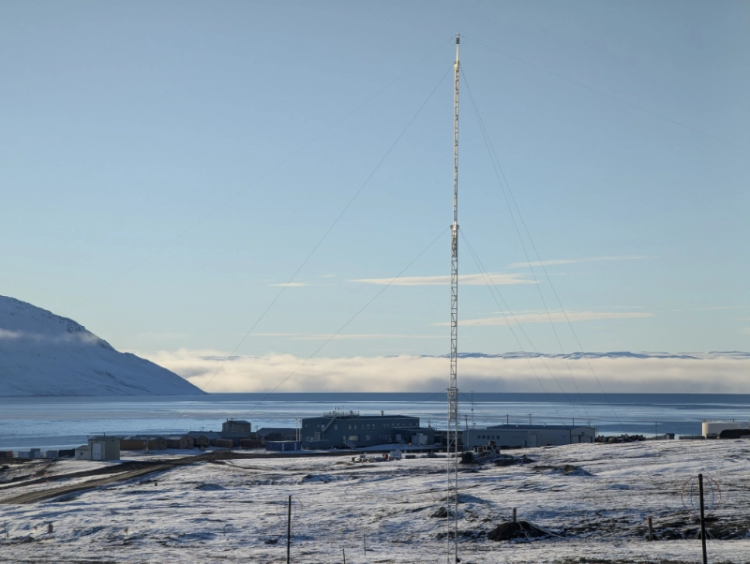
Canadian High Arctic Ionospheric Network (CHAIN) radar antenna at Eureka, Nunavut.
Leadership in a growing field
Jayachandran is recognized as an expert in the field. Besides his profile in Impact, he recently attended the Arctic Council Assembly as a panellist for a session on "Cross-cutting activities for Geosciences, Atmospheric Physics and Space Sciences."
He was also invited by the Canadian government to participate as a panellist in the session on "Securing Canada's Arctic Future: Leveraging Emerging and Dual-Use Tech with Safeguard for Sovereignty, Security and Sustainable Development" at the 18th Canadian Science and Innovation Policy Conference.
His influence extends beyond the research itself. The scale of the research, the reach of the Arctic monitoring network, and years of work in both civilian and defence-related applications have helped establish UNB as a recognized leader.
Over nearly three decades, he has helped build a program that combines long-term Arctic observations, specialized infrastructure, highly trained personnel, and ties to national and international research efforts.
He has also trained students who have gone on to build research capacity elsewhere in industry, academia, and government.
"Former students and researchers from my group have gone on to enhance research capacity at other institutions, including the Space Environment and Radio Engineering (SERENE) Group at the University of Birmingham." Jayachandran said.
"There are not many institutions in the world which are capable of doing this kind of work. UNB, as an institution, is an expert in this field. Period."