


A $4.6 million investment from the Ontario government will expand the production of life-saving medical isotopes at the McMaster Nuclear Reactor (MNR), ensuring more cancer patients can access critical treatments.
The investment builds on the government's previous $18 million investment to expand MNR's operations to 24 hours a day, seven days a week, supporting increased production of custom isotopes needed to develop new drugs.
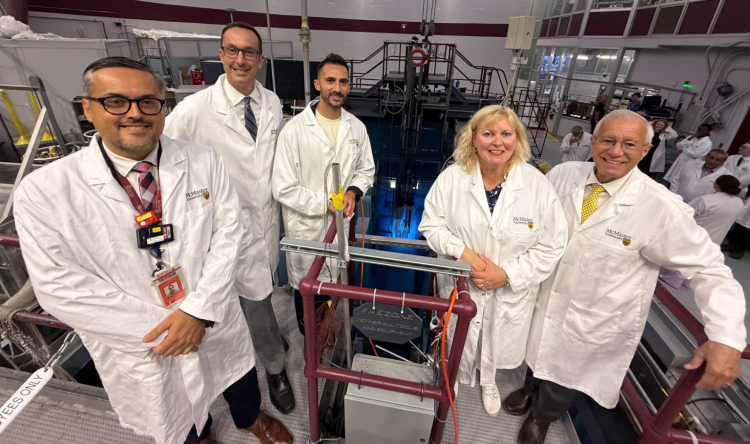
From left: Josip Zic, Chief Nuclear Officer at McMaster University; Nolan Quinn, Minister of Colleges, Universities, Research Excellence and Security; Stephen Lecce, Minister of Energy and Mines; Susan Tighe, President and Vice-Chancellor of McMaster University; and Victor Fedeli, Minister of Economic Development, Job Creation and Trade. (Georgia Kirkos/McMaster University).
Together, these investments will increase the reactor's research capacity by 300 per cent and enable the production of isotopes for up to 84,000 cancer treatments each year.
"As Canada's Nuclear University, McMaster is committed to translating nuclear research into real-world impact," said McMaster President Susan Tighe.
"This investment strengthens our ability to produce critical medical isotopes, support groundbreaking research, provide hands-on training for students and help deliver better outcomes for patients in Ontario and around the world."
Today's (July 29) announcement brings the Ontario government's total investment in the McMaster Nuclear Reactor to $26.9 million.
"Cancer impacts us all, and Ontario is proudly leading the development of innovative solutions that save lives and make a meaningful difference for our loved ones," said Nolan Quinn, Minister of Colleges, Universities, Research Excellence and Security.
"This investment will ensure that Ontario families continue to have access to cutting-edge, homegrown treatments, while strengthening and protecting Ontario's position as a global leader in nuclear medicine."
Radioisotopes are essential in diagnosing and treating cancer. McMaster supplies 60 per cent of the world's iodine-125, a medical isotope used to treat various cancers. The McMaster Nuclear Reactor currently provides cancer treatments for over 70,000 patients each year.
"With two in five Canadians expected to be diagnosed with cancer in their lifetime, increasing the capacity of the McMaster Nuclear Reactor means increasing hope for patients," said Stephen Lecce, Minister of Energy and Mines.
"Ontario has a plan to double medical isotope production by 2030, with this investment expanding production capacity, accelerating world-class research and strengthening our position as a global leader in nuclear innovation. Our government is bringing life-saving diagnostics and treatments to more patients across Ontario and around the world."
Expanding operations at MNR to 24/7 will significantly increase the facility's neutron output, creating more jobs and research opportunities while driving the development of more lifesaving, targeted therapies to meet the growing demand for medical isotopes in Canada and globally.
"Through continued investment in the McMaster Nuclear Reactor, our government is reinforcing Ontario's leadership in medical isotope innovation and expanding access to life-saving treatments for patients at home and around the world," said Vic Fedeli, Minister of Economic Development, Job Creation and Trade.
"As we continue to deliver on the goals outlined in our Life Sciences Strategy, today's announcement affirms the importance of cultivating a strong, STEM workforce and the positive impact Ontario's nuclear medicine advantage holds for the broader economy."