


An Indigenous approach to water management is at the heart of a two-year research project in Northern Ontario involving three universities and Cambrian College.
The project brings together Indigenous youth in Northern Ontario to learn about Indigenous water law and its importance to protecting water and supporting sustainable development.
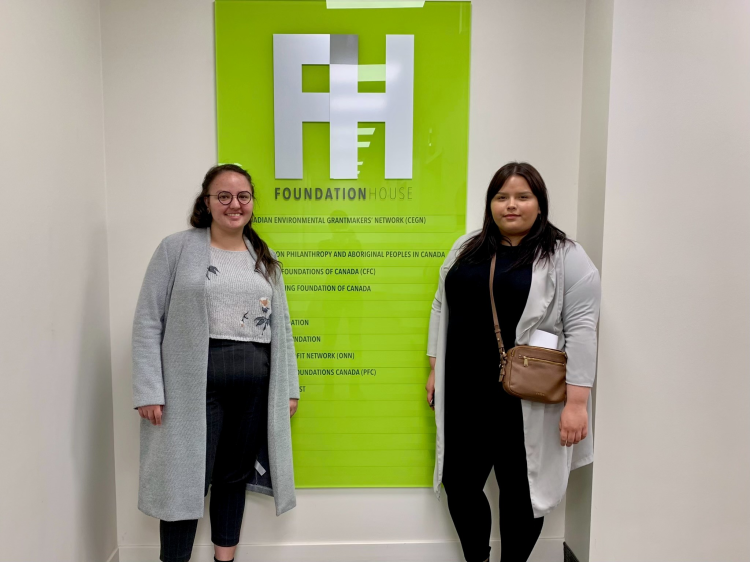
Kaella-Marie Earle and Denise Boyer-Payette are two of the researchers in a project, funded by the Laidlaw Foundation, to together Indigenous youth in Northern Ontario to learn about Indigenous water law and its importance to protecting water and supporting sustainable development.
It is made possible through $60,000 in funding from the Laidlaw Foundation. The Government of Ontario is also supporting the project.
The research team includes Dr. Josh Manitowabi of Brock University, lead researcher and supervisor; Dr. Kelsey Leonard of the University of Waterloo and lead researcher; Denise Boyer-Payette, band councillor with the Mississauga First Nation (Blind River) and co-lead; and Kaella-Marie Earle of Queen's University, master's candidate and researcher. Earle is also a Cambrian College graduate, who completed Cambrian's three-year advanced diploma in Chemical Engineering Technology in 2016. She currently serves as President of the Canadian Aboriginal Minerals Association.
The first phase of the project will focus on two summits in Sault Ste. Marie for Indigenous students.
The first summit is being held October 23 to 26 at Shingwauk Kinomaage Gamig, an Indigenous post-secondary institution in Sault Ste. Marie.
This project is also about international diplomacy. Anishinaabe academics and leaders will be co-creating a weaving in partnership with visiting experts and academics from Lac Courte Oreilles Band of Lake Superior Chippewa Indians in Wisconsin. A flag of the Lac Courte Oreilles Band will be raised.
"Through the Nibi Inaakinogewin Fellowship, we aim not only to amplify the implementation of Indigenous legal orders, but also to affirm our commitment to the relationship with our Native American relatives in the United States," says Kaella-Marie Earle. "The Assembly of First Nations (AFN) and the National Congress of American Indians (NCAI) renewed their Declaration of Kinship and Cooperation among the Indigenous Peoples and Nations of North America on March 24, 2026. Our team takes this commitment to peace seriously, and by raising each others flags we commit to harmony and strength among our peoples."
Cambrian R&D, the college's applied research division, is participating in the project as the organizational mentor. Cambrian R&D will disburse project funds, help ensure the project remains on budget, and provide technical and administrative support to the researchers.
The project could also lead to further collaboration with Cambrian College. A future phase could include similar youth summits in Sudbury and the potential use of Cambrian's Chemical Analyses and Scientific Services (CASS) laboratory for water testing. There may also be opportunities for Cambrian students to participate in field work involving water sampling and testing.
"Responsible resource development requires us to consider not only how we use land and water, but also the knowledge, laws and perspectives that inform those decisions," says Dr. Mike Commito, Director of Cambrian R&D. "As part of Cambrian's commitment to advancing sustainability in the mining sector, we are pleased to support this project and greater awareness of Indigenous water law. We also see exciting possibilities for future collaboration that could bring together Indigenous knowledge, applied research and the technical expertise we have here at Cambrian."
For more information

1400 Barrydowne Road
Sudbury Ontario
Canada P3A 3V8
www.cambriancollege.ca/